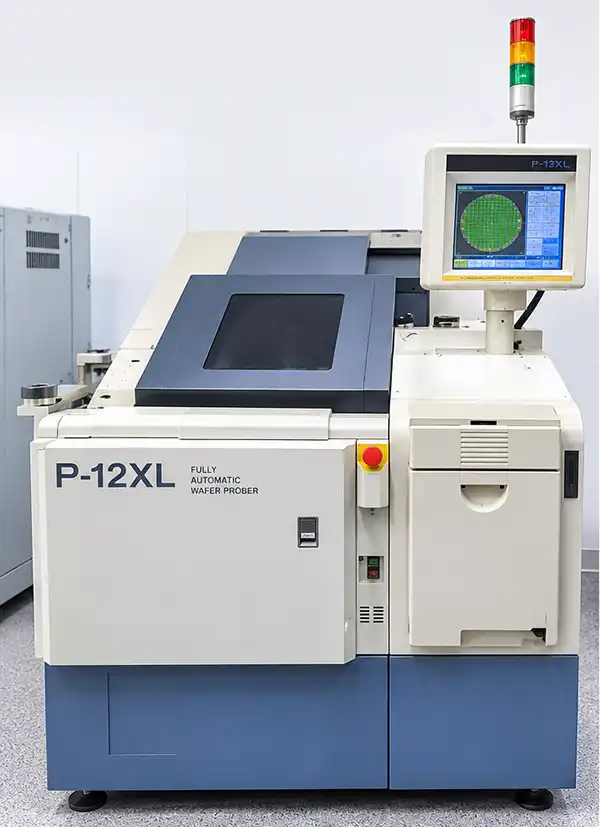
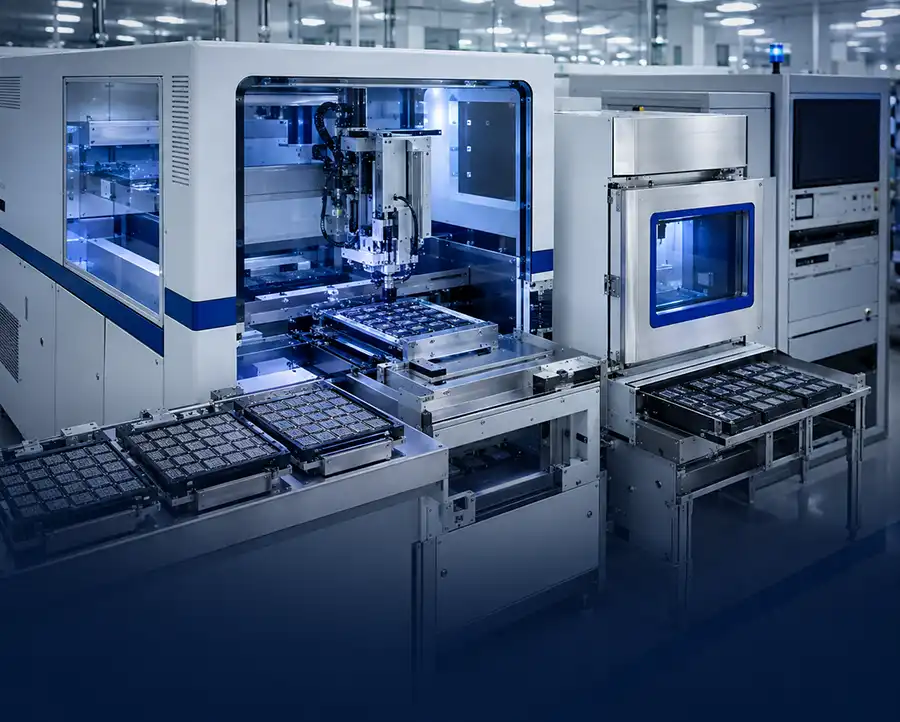
Engineering Summary: Preparing a 725–775 µm fab wafer for modern thin-package or stacked-die assembly requires four tightly sequenced operations: backgrind tape lamination, coarse/fine wafer grinding (plus optional edge trimming and dry stress-relief polishing), UV frame tape mounting, and high-purity wafer cleaning. Treating these four machines as a single integrated stress-control chain prevents edge chipping, wafer warpage, and adhesive transfer defects.
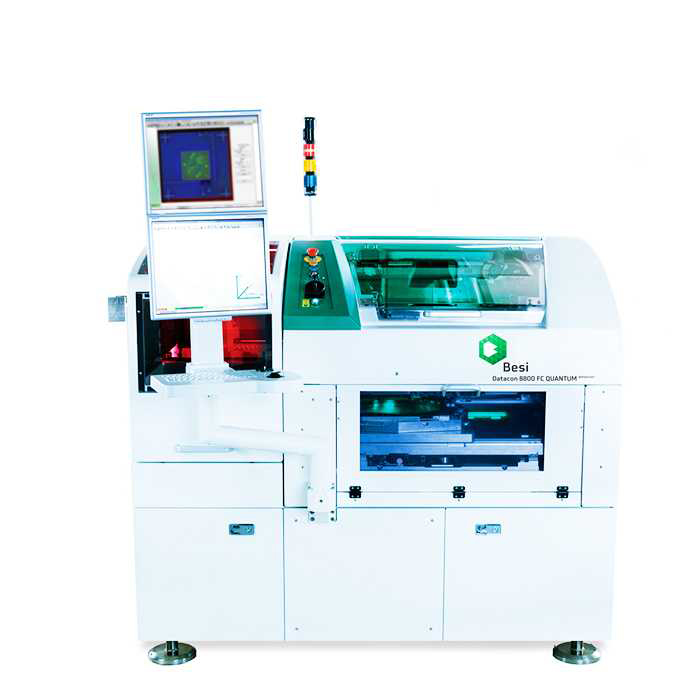
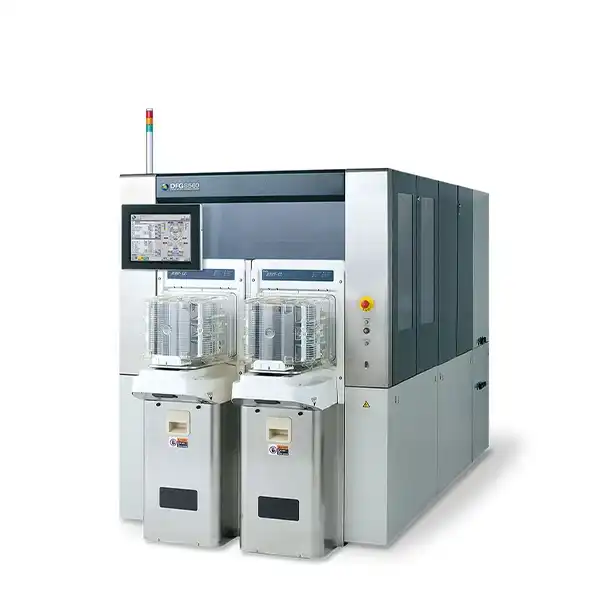
- Wafer Grinding Equipment: Coarse (Z1) + Fine (Z2) dual-spindle grinders (DISCO DFG8541/DFG8560) achieve < 2 µm TTV; stress-relief polishers (DISCO DGP8761) reach 25–50 µm dies.
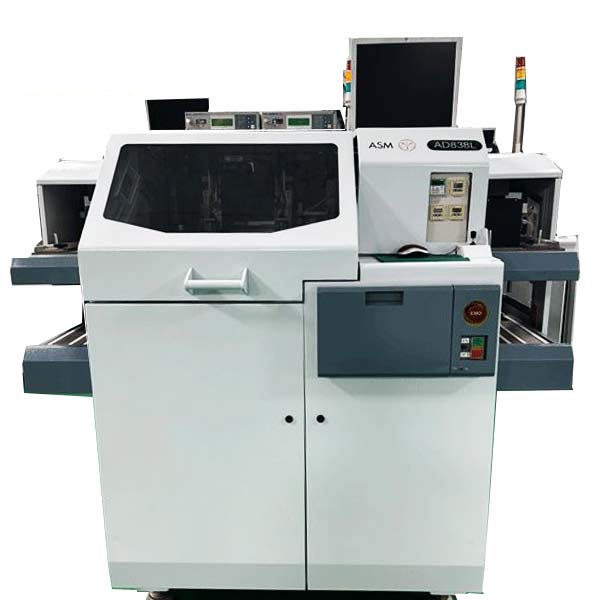
- Wafer Edge Grinder: Removes beveled wafer edges before ultra-thin grinding (< 100 µm) so knife-edge silicon rims never shatter on the chuck.
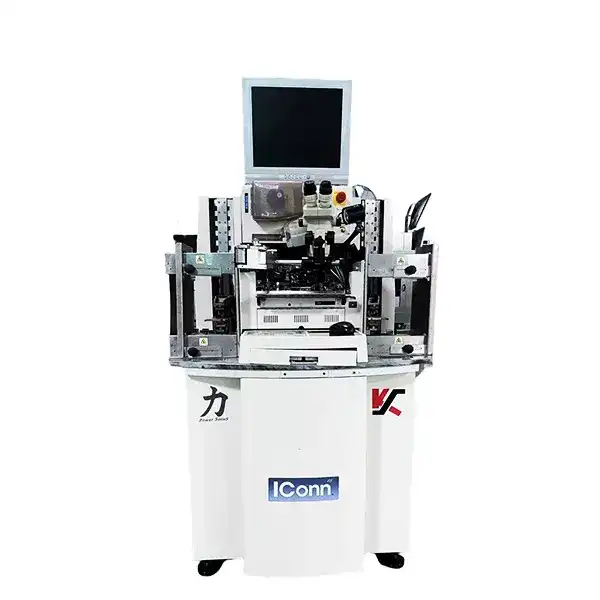
- Wafer Mounter & Cleaner: Vacuum non-contact laminators (Nitto DR8500III, SINTAIKE STK-7080) and megasonic/two-fluid cleaners (SEMES BLUEICE, SC810) eliminate trapped bubbles and slurry particles.
Why Thin-Wafer Packaging Fails When Grinding, Mounting & Cleaning Are Isolated
Standard 300 mm silicon wafers exit front-end fabrication at 775 µm thickness (200 mm wafers at 725 µm), yet stacked mobile NAND, ultra-thin QFN, and low-Rds(on) SiC/IGBT power chips must be thinned to 150 µm, 75 µm, or even 30 µm before dicing. At those thicknesses, silicon behaves like crisp cellophane: a 5 µm tape bubble left by the laminator turns into a dimple during grinding, a sharp beveled wafer edge shatters inside the cassette, and microscopic silicon dust left after cutting causes immediate die-attach tilting.
Stage-by-Stage Equipment Selection Across the Wafer Prep Line
| Workflow Stage | Core Machine Class | Process Physics & Critical Spec | Catalog Platforms |
|---|---|---|---|
| 1. Edge Trimming | Wafer Edge Grinder / Trim Saw | Mills a 1–3 mm rectangular step around wafer perimeter prior to BG so thinned edges stay square, not razor-sharp | Wafer Grinding & Edge Grinder Equipment |
| 2. Backgrinding & Stress Relief | Wafer Grinder / Polisher | Z1 coarse wheel (#320–#600) removes bulk at 3–5 µm/s; Z2 fine wheel (#2000–#4000) controls TTV < 2 µm; dry polish removes subsurface micro-cracks | DISCO DFG8560, DFG8541, DGP8761 Polisher, DFG8830 |
| 3. Frame Tape Mounting | Wafer Mounter Machine | Tension-controlled UV or dicing-tape lamination onto metal ring frames with automated BG tape peel and optional DAF transfer | Nitto DR8500III, Nitto DR3000III, SINTAIKE STK-7080, STK-6020 |
| 4. Post-Process Cleaning | Wafer Cleaning Equipment | Removes grinding slurry, dicing swarf, flux residues, and organic films using two-fluid spray, megasonic agitation, and N2 spin dry | SEMES BLUEICE PRIME 300mm, SC810, FC750, AC-420 |
When You Need a Wafer Edge Grinder or TAIKO Grinding
Every prime silicon wafer arrives from the ingot supplier with a rounded edge bevel. As a standard wafer grinder thins the wafer down past ~100 µm, that rounded bevel becomes a paper-thin razor edge that flakes off during robot transfer and scratches adjacent dies. Engineering teams prevent edge breakage using one of two methods: running a wafer edge grinder step before thinning (trimming 1.5–2.5 mm off the outer perimeter to a depth deeper than final wafer thickness), or running DISCO TAIKO grinding on a grinder-polisher like the DGP8761, which leaves an unground 3 mm outer support ring intact until ring-frame mounting.
Non-Contact Vacuum Wafer Mounters for Bumped & Ultra-Thin Wafers
Conventional roller-style wafer mounter machines work reliably on flat, unbumped 150–300 µm wafers. Once wafers feature 80–200 µm tall flip-chip solder bumps or drop below 75 µm thickness, roller pressure traps air pockets around bump bases and induces fatal bow stress. Non-contact vacuum laminators such as the SINTAIKE STK-7080 evacuate the chamber before conforming compliant BG or dicing film uniformly around tall bumps—preventing water ingress during subsequent grinding and sawing.
Engineering Checklist for Qualifying Wafer Prep & Cleaning Lines
- Verify Chuck Table Porosity & Self-Grind Geometry: On a wafer grinder, confirm the porous ceramic chuck tables are free of micro-cracks and inspect chuck tilt adjustment screws that set concave/convex TTV compensation.
- Check Tape Tension & Cut-Blade Alignment on Mounters: Confirm smooth tape unwind tension (< 5% variance), circular cutter blade tracking (zero tape shreds around the metal ring frame), and optional UV irradiation uniformity if mounting UV-release dicing tape.
- Match Wafer Cleaner Chemistry & Nozzle Technology: For bare silicon or front-end 300mm wafers, verify single-wafer wet/cryogenic or megasonic cleaners like the SEMES BLUEICE PRIME; for post-reflow flip-chip or LED strips, verify multi-stage aqueous spray and air-knife drying platforms like SC810 or FC750.
- Validate Slurry Filtration & Wastewater Capacity: Wafer grinders generate steady silicon-particle slurry; size closed-loop filtration and pH neutralization alongside the grinder so clogged drains never back up into spindle seals.
Related Wafer Processing Systems & Spares
- Wafer Grinding & Edge Grinder Equipment
- Automatic Wafer Mounter Machines (Nitto & SINTAIKE)
- Semiconductor Wafer Cleaning Equipment & Package Cleaners
- DISCO Wafer Grinder Spare Parts & Height Gauge Amps
- Matched Wafer Grinding, Mounting & Dicing Line Solutions
- DISCO Dicing Saws & Wafer Grinders Comparison
Frequently Asked Questions
What is the difference between a standard wafer grinder and a grinder-polisher like DISCO DGP8761?
A standard wafer grinder (such as DFG8541 or DFG8560) uses coarse and fine diamond wheels to thin wafers to target thickness quickly. A grinder-polisher (like DGP8761) adds a dry polishing or CMP stress-relief wheel that removes the 1–3 µm subsurface damaged crystal layer left by diamond grit—tripling die fracture strength on ultra-thin (< 75 µm) chips.
Why do some thin-wafer processes require a wafer edge grinder before backgrinding?
Thinning a standard bevel-edged wafer below ~100 µm turns the curved edge into a sharp, fragile knife-edge that chips and cracks spontaneously. Edge grinding trims 1–3 mm around the outer wafer rim before thinning so the remaining perimeter stays thick and blunt.
When should I use a vacuum non-contact wafer mounter instead of a roller mounter?
Use a vacuum laminator whenever wafers have high-topography solder bumps, copper pillars, MEMS trenches, or thicknesses under 75 µm where roller lamination traps air voids around bumps or cracks thin silicon.
How does semiconductor wafer cleaning equipment differ from plasma cleaning?
Wet wafer cleaning equipment uses DI water, megasonic waves, two-fluid sprays, or mild aqueous chemistries to physically flush away particulates, grinding slurry, and bulk flux residues. Plasma cleaning is a dry vacuum process using ionized O2/Ar gas to strip nanoscale organic contamination and chemically activate surfaces right before bonding or molding.