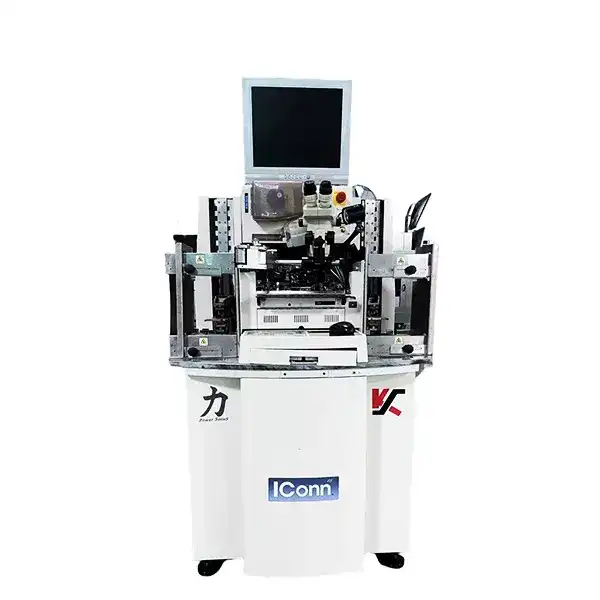
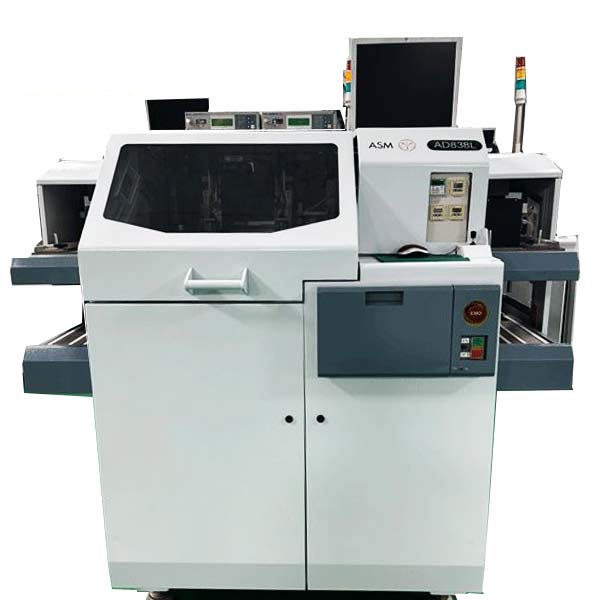
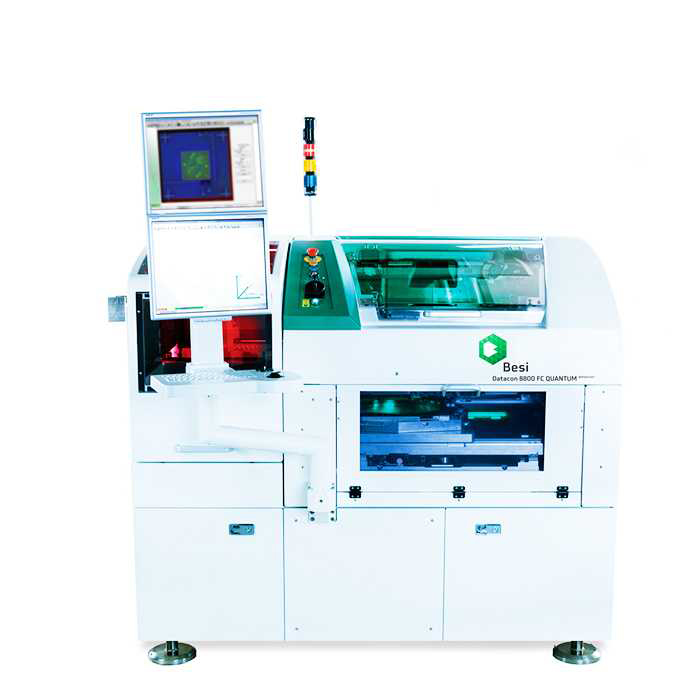
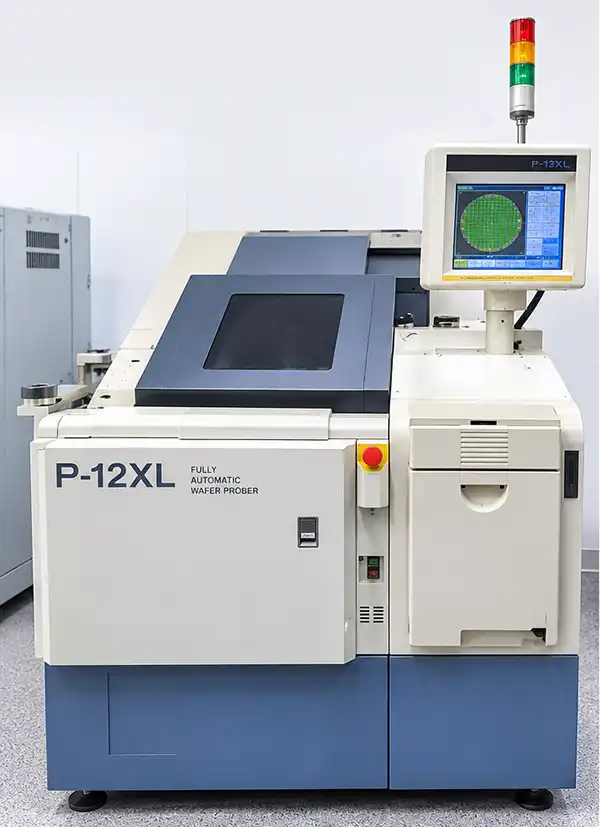
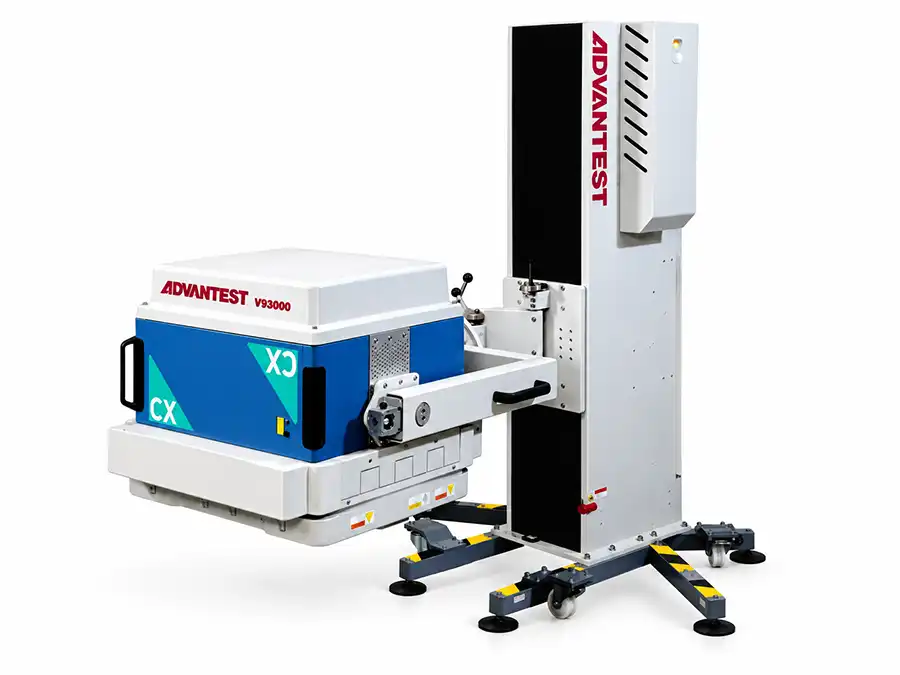
Engineering Summary: Final IC test handlers automate loading, thermal conditioning, ATE socket plunging, optical inspection, and pass/fail binning of packaged semiconductors. Pick-and-place handlers dominate tray-based BGA/QFP/QFN multi-site tri-temp testing (4–64 sites); rotary turret handlers lead ultra-high-UPH small-package and reel-to-reel sorting (20,000–50,000+ UPH); and gravity handlers deliver lowest cost per test for leaded SOP, TSSOP, and TO power packages.
- Pick-and-Place: Best package protection for delicate BGA solder balls and large QFPs; wide thermal range (-55°C to +155°C).
- Turret Test Handler: 16–32 rotary index stations combining electrical test, 3D lead/mark vision, laser marking, and tape-and-reel in one footprint.
- Gravity Handler: Simplest mechanical path, smallest cleanroom footprint, and rapid tube-to-tube throughput for discrete and analog ICs.
Matching Handler Mechanics to Package Geometry and Test Time
In final IC test, your ATE tester cost per second is fixed—so every millisecond the IC test handler spends indexing, waiting for thermal soak, or recovering from a package jam erodes gross margin directly. Choosing between a Pick and Place Handler, a turret test handler, and a gravity handler starts by plotting two numbers: package body size/fragility and ATE electrical test time.
Short-test-time devices (< 100 ms per site, such as discrete MOSFETs, diodes, small QFN/DFN, or WLCSP) are index-time limited: only a high-speed rotary turret or multi-track gravity handler keeps the tester busy. Complex SoCs, automotive MCUs, and RF modules requiring 2–15 seconds of electrical test time are test-time limited: maximizing multi-site parallelism (8, 16, 32, or 64 sockets simultaneously) on a pick-and-place handler produces far higher factory output than raw mechanical index speed.

Engineering Comparison: Pick-and-Place vs. Turret vs. Gravity Test Handlers
| Selection Criteria | Pick-and-Place Handler | Rotary Turret Test Handler | Gravity-Feed Handler |
|---|---|---|---|
| Package Families | BGA, QFP, QFN, LGA, SIP, automotive modules (5 × 5 to 55 × 55 mm) | WLCSP, DFN, small QFN, SOT, SOD, LEDs, bare die (0.4 × 0.2 to 12 × 12 mm) | SOIC, SOP, TSSOP, MSOP, DIP, TO-220/247/263 power packages |
| Input / Output Media | JEDEC tray-to-tray (optional tube/reel) | Vibratory bowl, wafer ring, or bulk to tape-and-reel | Tube-to-tube or tube-to-tape |
| Thermal Capability | Ambient, Hot (+155°C), Tri-Temp (-55°C to +155°C), Active Thermal Control | Primarily Ambient to Hot (+125°C / +150°C); specialized cold options | Ambient, Hot (+155°C), Tri-Temp (-55°C to +155°C) |
| Typical Parallelism | 2, 4, 8, 16, 32, up to 64 sites | 1–4 sequential or dual-test stations | 2, 4, 8, up to 16 parallel tracks |
| Key Strength | Zero lead/ball impact; high-site SoC throughput & active thermal control | Combines electrical test + 5-side/6-side AOI vision + laser mark + reel pack | Lowest CAPEX, tiny footprint, lowest change-kit cost for leaded packages |
| Representative Models | Advantest M4841/M4871, Cohu Delta Castle/Matrix, Hon Tech, SRM | Cohu Ismeca NY20, ASM Sunbird X8, ASMPT MS90, ASM MS60 | Cohu Rasco SO1000/SO2000, Advantest M6242/M6300, Multitest MT9510 |
Why Change Kits and Thermal Soak Architecture Dominate Total Ownership Cost
A common budgeting surprise when purchasing an Advantest handler, Cohu Ismeca turret, or pick-and-place system is underestimating package-specific conversion kits. Every unique package body size requires its own precision change kit (preciser nests, plunger tips, shuttle carriers, soak-plate tracks, and socket docking stiffeners). On a 16-site tri-temp pick-and-place handler, a single new package change kit can cost $18,000–$45,000—whereas a standard gravity track kit costs a fraction of that.
Equally important for automotive and server SoC testing is thermal control strategy:
- Passive Soak Chamber: Devices pre-heat or pre-cool in a forced-convection soak chamber prior to plunging. Works smoothly for low-power MCUs (< 3–5 W self-heating).
- Active Thermal Control (ATC): High-power processors and automotive ADAS SoCs dissipate 20–150+ W during burst patterns, causing junction temperature to spike 30°C in milliseconds. ATC plungers integrate closed-loop liquid cooling and fast-response heaters directly behind each DUT to hold Tj within ±2°C throughout test execution.
Pre-Purchase Verification Checklist for Semiconductor Test Handlers
- Audit Installed Site Configuration & Pitch: Confirm exact test-site matrix (e.g., 2×4, 4×4, 2×8), X/Y site pitch in millimeters, and whether the docking plate matches your existing ATE load board.
- Inspect Plunger Force & Coplanarity: High-pin-count BGA elastomeric sockets require 10–30 kgf per site; verify pneumatic/servo contact force calibration and plunger parallelism so corner balls make clean contact.
- Verify Tri-Temp Dry-Air & LN2 / Chiller Interface: For cold testing (-40°C / -55°C), inspect door gasket integrity, heater defrost circuits, LN2 solenoid valves (or mechanical chiller), and condensation-free sight glasses.
- Test Vision Cameras & Tape-and-Reel Modules (Turrets): Confirm 2D/3D coplanarity inspection cameras, peel-force sealer stability, and rotary index servo repeatability across a 5,000-unit dry cycle.
- Confirm Spare Parts Availability: Check availability of wear components—vacuum ejectors, pick-up nozzles, linear guides, temperature controller boards, and driver cards (such as ASMPT Sunbird drivers and MS90 turret spares).
Related IC Test Handlers, Feeders & Support Resources
- Browse IC Test Handlers & Turret Sorting Systems
- Automated Test Equipment (Advantest V93000 & T2000)
- Custom ESD Vibratory Bowl Feeders for Test Handlers
- IC Test Handler & ATE Spare Parts Inventory
- Wafer Probe, Test Handler & ATE Cell Solutions
- IC Test Handler Jam Isolation & Tri-Temp Fault Diagnostics
Frequently Asked Questions
When is a turret test handler better than a pick-and-place handler?
A rotary turret handler excels for small packages (WLCSP, DFN, small QFN, SOT, LEDs) with short electrical test times (< 150 ms) that also need inline 5-side/6-side optical inspection, laser marking, and direct tape-and-reel packing at 20,000–50,000+ UPH.
What causes excessive package jams on pick-and-place IC test handlers?
The top root causes are worn pick-up nozzle tips leaking vacuum, warped JEDEC trays outside JEDEC outline tolerances, drifted preciser-nest alignment after change-kit swaps, and static buildup during low-humidity cold testing without active ionizers.
Can an Advantest or Cohu handler dock to different ATE testers?
Yes, provided you configure the correct mechanical docking stiffener plate, test-head manipulator height/tilt clearance, and electrical GPIB/TTL/RS-232 handler interface cable matched to the target ATE platform (such as Advantest V93000, T2000, or Teradyne UltraFLEX).
How long does a thermal soak cycle take when switching a tri-temp handler from +125°C to -40°C?
Depending on chamber thermal mass and whether LN2 injection or mechanical cascade refrigeration is used, full handler thermal transition and stabilization typically takes 25 to 45 minutes. Production floors minimize this loss by batching lots by temperature grade (e.g., running all hot lots sequentially before cooling).