Engineering Summary: Semiconductor Automated Test Equipment (ATE) validates DC parametrics, high-speed digital vectors, analog/mixed-signal waveforms, and RF performance at wafer sort and final package test. Sizing an ATE system depends on total digital pin count, maximum data rate (e.g., 1600 Mbit/s on Advantest V93000 PS1600), Device Power Supply (DPS) current channels, and test-head frame size—not just chassis generation.
- Core Chassis Architecture: Modular test heads house interchangeable digital pin cards, DPS power modules, analog/AWG/digitizer instruments, and RF cages.
- Scalable Platforms: Advantest V93000 and Advantest T2000 allow OSATs to reconfigure one base frame across MCU, PMIC, RF, and high-speed SoC lots.
- Test-Cell Uptime Rule: Card-slot configuration, liquid cooling health, and clean docking pogo pins decide test yield and multi-site repeatability.
Inside a Modular Semiconductor Tester: What You Are Actually Buying
Unlike standalone benchtop oscilloscopes or source-measure units, production semiconductor automated test equipment packs hundreds or thousands of synchronized high-speed channels inside a water- or air-cooled test head docked directly above a wafer prober or beneath an IC test handler. Two identically labeled test frames—say, two Advantest V93000 C400e or Smart Scale systems—can differ by 3× in real capability and market value purely based on the exact cards populated inside the cage.
Before drafting an RFQ for any ATE system, engineering teams should break requirements down into five card-level buckets: digital pin electronics (channel count, max data rate, vector memory depth), device power supplies (voltage/current per rail, ganging capability, fast transient response), mixed-signal/analog instruments (high-resolution ADC/DAC testing), RF ports (frequency ceiling up to 6–40+ GHz), and high-voltage VI sources for power management or SiC devices.
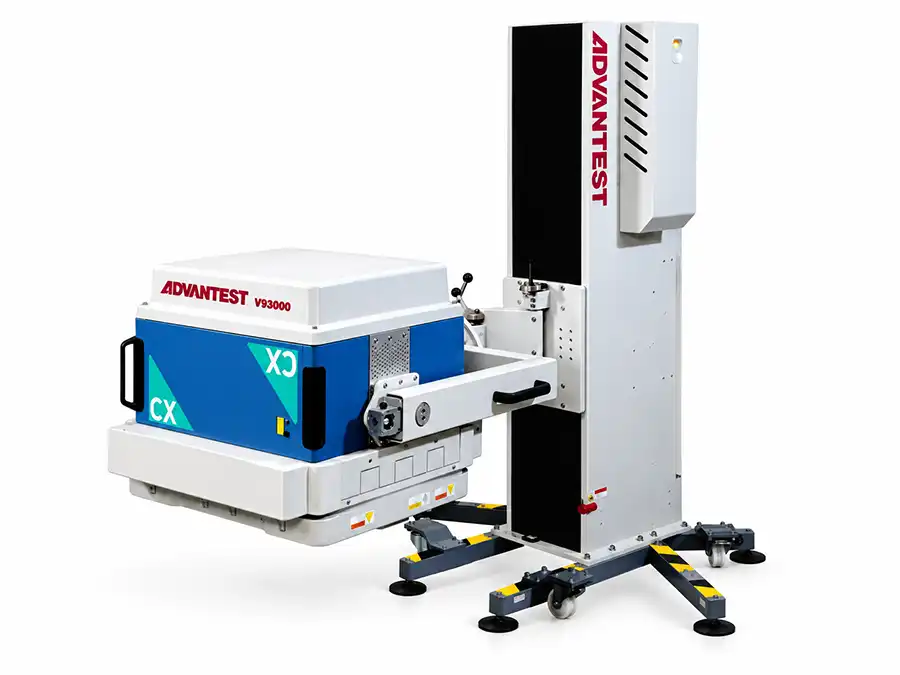
Comparing Major Production ATE Platforms by Device Segment
| ATE Platform Class | Representative Systems | Target Semiconductor Devices | Key Instrument Cards / Strengths |
|---|---|---|---|
| Scalable SoC / High-Speed Digital | Advantest V93000 (PS1600 / EXA Scale) | Application processors, MCUs, automotive SoCs, networking ASICs, RF transceivers | PS1600 128-ch cards, DPS64/DPS128, SmarTest OS, seamless multi-site scaling |
| Open-Architecture Modular SoC | Advantest T2000 | Automotive MCUs, CMOS image sensors, display drivers, mixed-signal SoCs | OPENSTAR modular modules, high-voltage power/analog options, compact floor cost |
| Analog / PMIC / Power Discrete | Teradyne ETS-88/364, Advantest T2000 IPS/MFT | PMICs, LDOs, DC-DC converters, gate drivers, SiC/GaN power MOSFETs | High-voltage/high-current VI floating sources, low-noise audio/analog instrumentation |
| High-Parallelism Memory ATE | Advantest T5503/T5830, Teradyne Magnum | DRAM, LPDDR, NAND Flash, NOR Flash | Algorithmic pattern generators (ALPG), 128–512+ DUT wafer/final parallelism |
Test Cell Integration: Docking the ATE Head to Probers and Handlers
Even a perfectly calibrated semiconductor tester will bleed yield if mechanical and electrical docking into the test cell is treated as an afterthought. Every inch of extra signal path between pin-card pogo pins and the DUT socket degrades edge rise time and adds parasitic inductance.
- Manipulator Geometry & Weight Rating: Large 64-slot test heads exceed 500–800 kg. Confirm manipulator arm reach, 180° tumble/pitch clearance for wafer prober docking (test head inverted face-down) vs. gravity/pick-and-place handler docking (vertical or horizontal), and cleanroom floor load capacity.
- Pogo Tower & Load Board Stiffeners: Inspect elastomeric or spring-loaded pogo blocks under magnification; bent or oxidized pogo pins generate intermittent site-specific continuity fails that masquerade as bad silicon.
- Host Software & STDF Data Pipeline: Confirm workstation OS revision (Linux SmarTest 7/8 on V93000), floating vs. node-locked license keys, and GPIB/Ethernet driver stability with your wafer prober and IC test handler.
5-Point Acceptance Protocol for Semiconductor Test Equipment
- Verify Exact Card Part Numbers & Revisions: Confirm every PS1600, PS9G, DPS64, DPS128, and analog/RF card serial number and hardware revision against your test program's minimum hardware table.
- Run Full System Diagnostics & Calibration: Confirm zero failing channels across DC continuity, PMU accuracy, timing deskew, and DPS current-clamp diagnostics.
- Inspect Liquid Cooling Loop & Interlocks: On liquid-cooled test heads, inspect quick-disconnect couplings, manifold flow sensors, coolant conductivity, and heat exchanger fans to prevent thermal shutdowns.
- Confirm Software Licenses & Backup Media: Audit per-pin data rate licenses (e.g., 400 Mbps vs. 800 Mbps vs. 1600 Mbps keys on PS1600), vector memory depth unlocks, and system recovery images.
- Plan Card-Level Spare & Repair Coverage: Keep at least one hot-spare digital card and DPS module per 4–6 active test heads, supported by board-level ATE board repair to avoid 12-week OEM exchange waits.
Related ATE Systems, Tester Cards & Repair Support
Frequently Asked Questions
What determines the price of an Advantest V93000 ATE system?
A V93000 system's price is driven primarily by its populated card cage—specifically the count and speed license of digital pin cards (PS1600, PS9G), DPS power modules, RF/mixed-signal instruments, test-head frame size, manipulator, and chiller—rather than the base frame year alone.
Can failed ATE pin electronics or DPS cards be repaired instead of replaced?
Yes. Many failures on V93000 PS1600, DPS, and power distribution boards trace to discrete power MOSFETs, relay arrays, DC-DC converters, or damaged ESD protection components. Board-level ATE board repair restores failed cards at 30–50% of OEM exchange pricing.
What is the difference between Advantest V93000 and Advantest T2000?
Both are modular SoC testers, with V93000 holding the widest global OSAT installed base for high-speed digital, mobile, networking, and RF SoCs under SmarTest software, while T2000 offers an open-architecture modular platform widely deployed across automotive MCUs, power/mixed-signal devices, and image sensors.
How often should a production semiconductor tester undergo system calibration?
Most ISO/IATF-16949 OSATs execute automated software system calibration weekly or after every major board swap, paired with NIST-traceable external metrology verification every 6 to 12 months.