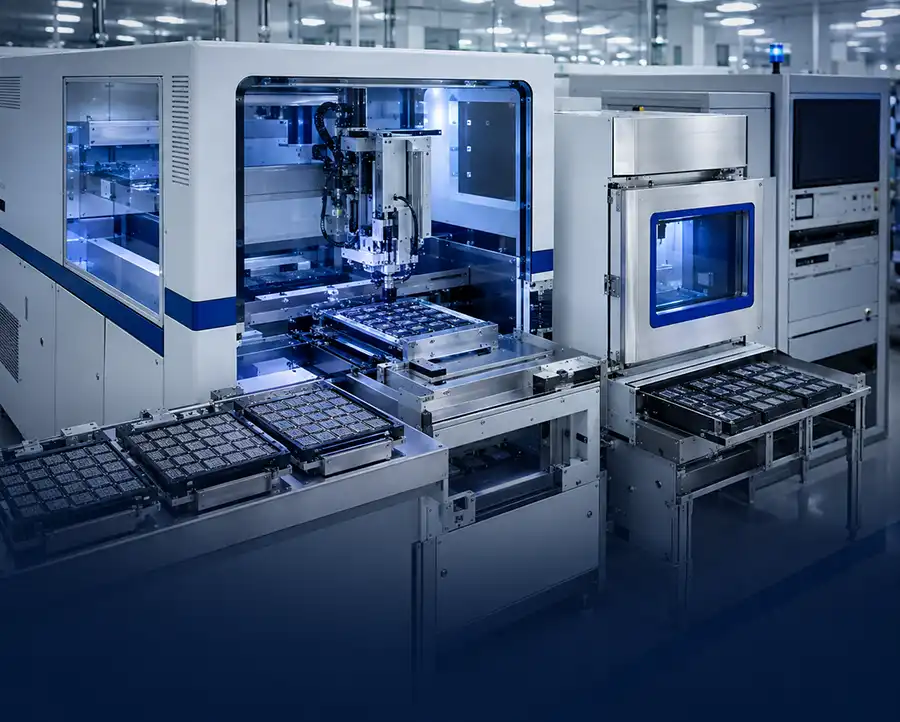
Engineering Summary: DISCO Corporation sets the global benchmark for back-end wafer singulation and thinning through four core series: DAD (single-spindle compact automatic/manual dicing saws), DFD (high-throughput facing dual-spindle automatic saws), DFL (stealth & ablation laser saws), and DFG/DGP (automatic dual-spindle wafer grinders and dry stress-relief polishers). Matching spindle torque, max wafer/workpiece size, and chuck flatness to your substrate avoids chronic chipping and blade stalling.
- DISCO DAD Series (DAD324 / DAD3230 / DAD3241): Compact single-spindle precision saws for 6"–8" silicon, ceramics, glass, QFN strips, and pilot lines.
- DISCO DFD Series (DFD6341 / DFD6361): Dual facing spindles for 8"–12" high-volume dual-cut and anti-chip step-cut production.
- DISCO DFL & DFG/DGP Series: DFL7341 dry stealth laser dicing paired with DFG8541/DFG8560 thinning and DGP8761 ultra-thin polishing.
Decoding DISCO Model Prefixes: DAD, DFD, DFL, DFG & DGP
Engineers sourcing a DISCO dicing saw or wafer grinder quickly notice how logical DISCO's model taxonomy is once decoded: DA indicates single-spindle dicing, DF denotes dual-spindle (facing) dicing or grinding, the third letter marks the process (D = Dicing blade, L = Laser, G = Grinding, P = Grinder-Polisher), and the four-digit code tracks wafer diameter (200 mm vs. 300 mm) and control generation.
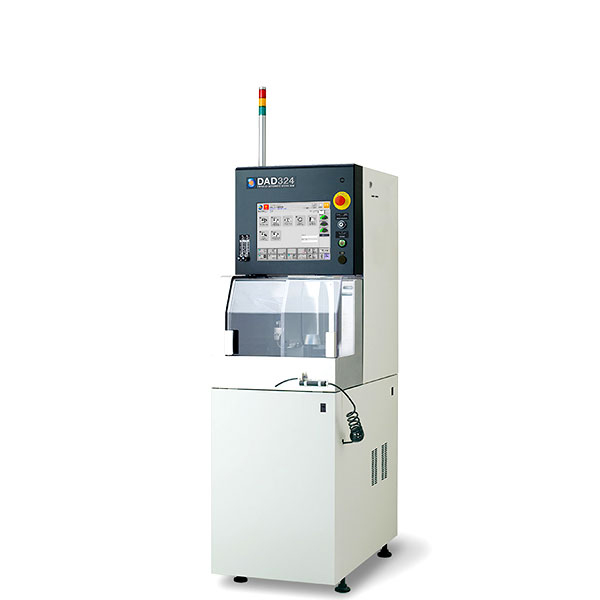
Side-by-Side Comparison of DISCO Wafer Saws & Grinders
| DISCO Model | Spindle / Beam Setup | Max Wafer / Workpiece | Typical Spindle Power | Best Manufacturing Application |
|---|---|---|---|---|
| DISCO DAD324 / DAD3230 | Single automatic spindle | Up to Ø 200 mm (8") | 1.8–2.2 kW (up to 60k RPM) | Mid-volume 6"–8" silicon, compound wafers, optical glass, ceramics, QFN |
| DISCO DAD3241 | Single manual/semi-auto spindle | Up to Ø 200 mm (8") | 1.8–2.2 kW | R&D labs, failure analysis, high-mix small-lot specialty substrates |
| DISCO DFD6341 / DFD6361 | Dual facing automatic spindles + spinner | Up to Ø 300 mm (12") (DFD6341: 200 mm) | 1.8–2.2 kW+ high-torque | High-volume OSAT dual-cut, step-cut anti-chipping, QFN & BGA strips |
| DISCO DFL7341 | Fully automatic laser saw (stealth/ablation) | Up to Ø 200 mm (8") | Pulsed precision laser head | Narrow-street (< 30 µm) thin silicon, low-k grooving, dry MEMS/SiC cutting |
| DISCO DFG8541 / DFG8560 | Dual coarse + fine grinding spindles | DFG8541: 200 mm; DFG8560: 300 mm | High-rigidity vertical BG spindles | High-volume wafer thinning to 75–200 µm with < 2 µm TTV |
| DISCO DGP8761 | Dual grinding + dry stress-relief polisher | Up to Ø 300 mm (12") | 3-spindle inline BG + polish | Ultra-thin 25–50 µm memory/power wafers requiring maximum die strength |
Single-Spindle DAD vs. Dual-Spindle DFD: When Does Dual Spindle Pay Back?
A single-spindle DISCO wafer saw like the DAD324 or DAD3230 occupies roughly half the cleanroom footprint and consumes far less DI water and CDA than a dual-spindle DFD machine. However, once daily wafer volume exceeds ~40–60 wafers/day on 8-inch silicon—or whenever brittle copper-metal streets demand a two-pass step cut—a dual-spindle DISCO DFD6341 or DFD6361 cuts cycle time by 40–48% and eliminates operator blade swaps between coarse and fine passes, typically paying back the CAPEX difference inside 9–14 months.
Pre-Purchase Technical Inspection for DISCO Saws & Grinders
- Check Spindle Hours, Runout & Current Draw: Run spindles up to rated RPM (30k–60k RPM on saws) while logging bearing vibration, axial/radial runout (< 0.5–1.0 µm), and air-bearing pressure interlocks.
- Verify Exact Chuck Table & Frame Size: Confirm 6", 8", or 12" porous ceramic chuck flatness (< 5 µm) and whether 2-8-1 vs. 2-12-1 frame cassettes and vacuum jigs are included.
- Inspect Y-Axis Ball Screw / Linear Scale & Bellows: Water mist from worn splash guards corrodes Y-axis rails over time—always inspect guideways beneath the bellows and run a multi-index pitch calibration.
- Test Microscope Alignment & Kerf-Check Optics: Confirm crisp dual-magnification focus, clear ring/coaxial illumination, and accurate automatic kerf-width tracking.
- Confirm Laser Cavity Health (on DFL7341): Verify laser diode pulse energy stability, power-meter calibration log, and optical cavity alignment—or confirm coverage via laser source repair.
Related DISCO Equipment, Spares & Repair Services
Frequently Asked Questions
What is the difference between DISCO DAD324 and DISCO DFD6341?
DAD324 is a compact single-spindle 8-inch automatic dicing saw suited for moderate volume, specialty materials, and space-constrained cleanrooms. DFD6341 is a full-size dual-spindle 8-inch production saw with facing Z1/Z2 spindles, integrated automatic cassette handling, and spin-rinse cleaning for nearly double the wafer throughput.
Can a DISCO DFD6341 or DAD324 cut SiC and GaN compound wafers?
Yes, provided the saw is equipped with high-torque spindles (typically 2.0–2.2 kW+), stiff resin or metal-bond diamond blades, slower feed rates (1–5 mm/s), and robust dressing boards. For high-volume SiC lines, many fabs combine laser grooving or stealth dicing (DFL series) with blade cutting to cut kerf loss.
What causes uneven wafer thickness (high TTV) on a DISCO DFG8560 or DFG8541 grinder?
Elevated TTV usually stems from an un-trued porous ceramic chuck table, drifted spindle tilt relative to the chuck plane, worn fine-grinding diamond wheel segments, or miscalibrated in-process thickness gauge amplifiers.
How often should DISCO water filter cartridges and DI flow meters be serviced?
Replace cutting-water filter cartridges (such as LKFH-010068-0) whenever differential pressure climbs or every 1–3 months depending on slurry load, and check flow-meter accuracy monthly so spindle cooling water never drops below minimum flow interlocks.