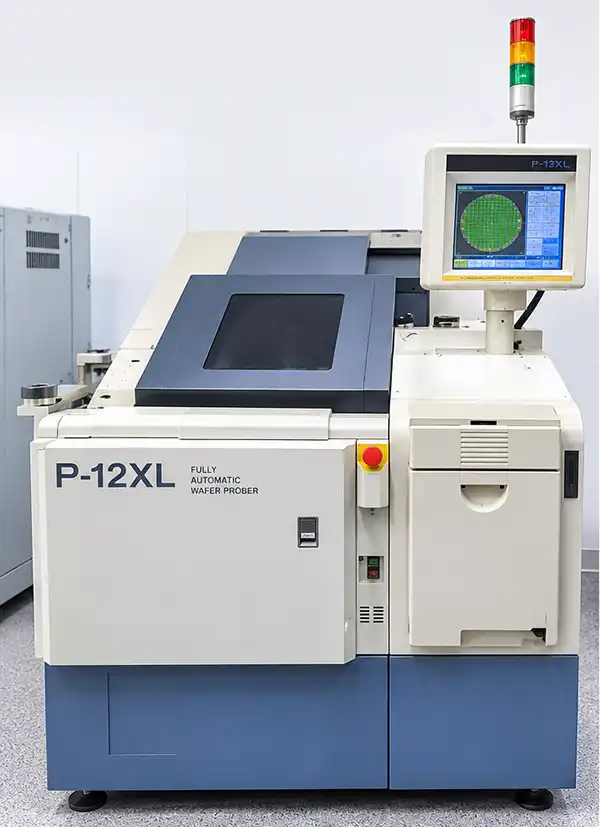
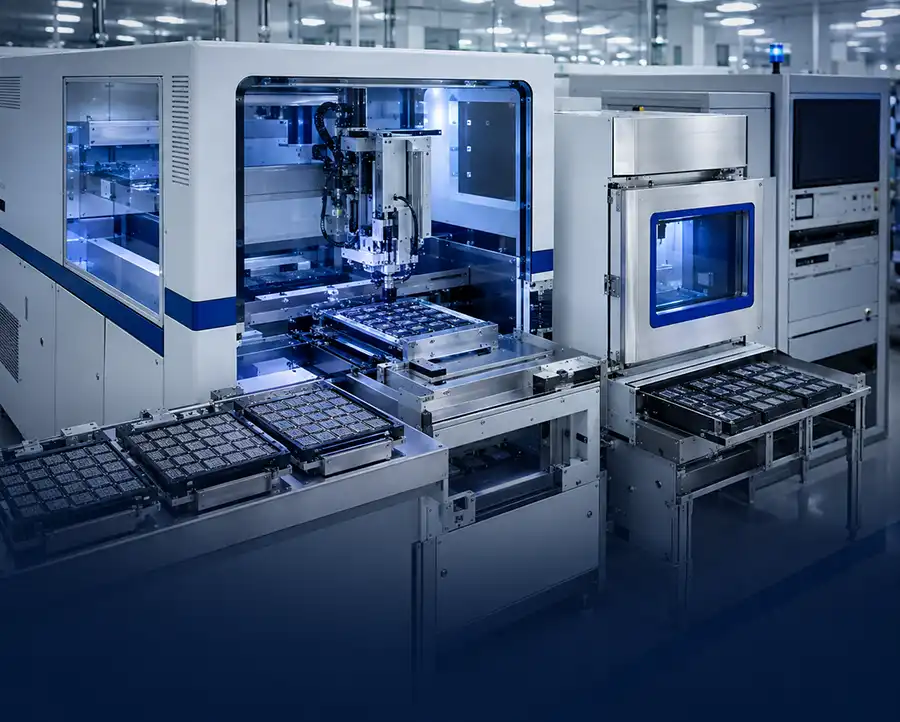
Engineering Summary: Under BE Semiconductor Industries (Besi), two iconic European die-attach lineages serve complementary manufacturing missions: ESEC platforms (led by ESEC 2100 hS and 2100 FC hS) maximize high-UPH leadframe epoxy and flip-chip productivity, while Datacon platforms (2200 Evo, 2200 APM, 8800 FC Quantum, and 8800 CHAMEO) dominate high-accuracy multi-chip SiP, advanced flip-chip, silver sintering, and fine-pitch heterogeneous packaging down to ±2–5 µm.
- Besi ESEC 2100 Series: High-speed rotary/direct-flip architecture for QFN, SOIC, BGA strips, and high-UPH flip-chip production.
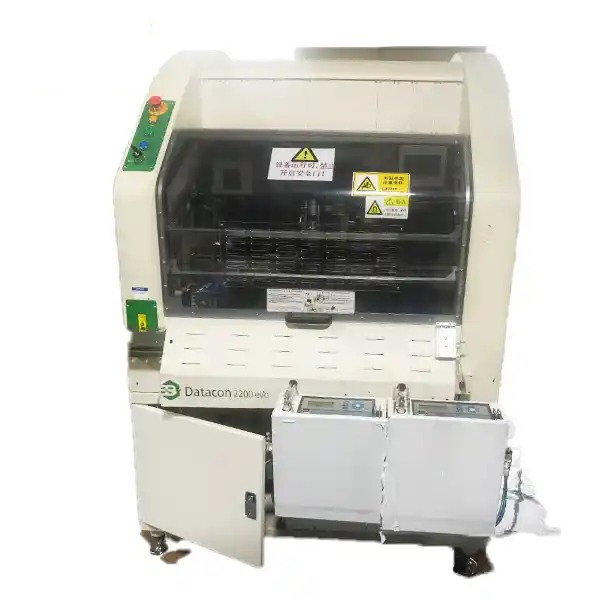
- Besi Datacon 2200 Evo & APM: Modular multi-chip gantry bonders handling mixed wafers, waffle packs, tape-and-reel, epoxy, DAF, and flip-chip in one cell.
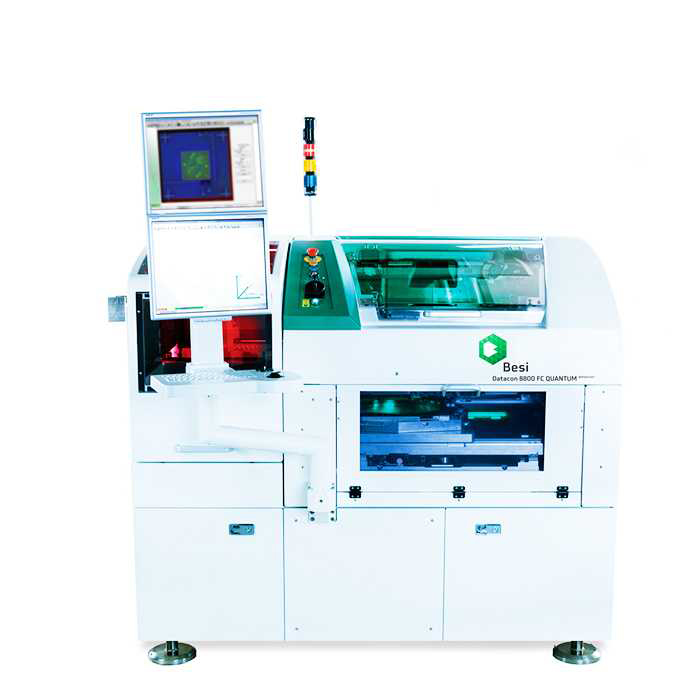
- Besi Datacon 8800 FC Quantum / CHAMEO: Sub-5 µm flagship flip-chip & hybrid accuracy platforms for high-density FC-BGA, chiplets, and optical modules.
Why European & Automotive OSATs Standardize on Besi Datacon & ESEC
Whereas ASMPT AD-series machines often win pure cost-per-UPH battles on standard commercial QFN leadframes, Besi Datacon and ESEC die bonders command unmatched loyalty across automotive electronics, RF front-end SiPs, power modules, and fine-pitch flip-chip lines. The engineering differentiator is modular flexibility paired with closed-loop thermal and mechanical stability: a single Datacon 2200 Evo chassis can switch seamlessly from bare silicon wafers to waffle-pack MEMS sensors, dip dies into controlled-thickness flux or silver-sintering paste, inspect backside bumps optically, and place them onto warped multi-layer substrates with repeatable sub-10 µm accuracy.
Platform Comparison: ESEC 2100 vs. Datacon 2200 Evo/APM vs. Datacon 8800 FC
| Besi Platform | Mechanical Architecture | Accuracy (3σ) | Core Process Modes | Best Production Role |
|---|---|---|---|---|
| Besi ESEC 2100 hS | High-speed direct pick-and-place leadframe bonder | ±15–25 µm | Epoxy writing/stamping, DAF, soft solder | High-volume automotive & industrial QFN, SOIC, power leadframe lines |
| Besi ESEC 2100 FC hS | Dual-stage flipper + high-UPH bond head | ±7–10 µm | Mass-reflow flip chip, flux dip, epoxy | High-throughput FC-CSP, FC-QFN, and RF flip-chip volume ramps |
| Besi Datacon 2200 Evo / 2200 APM | Flexible gantry + automatic tool bank + multi-feeder deck | ±5–10 µm | Multi-chip SiP, epoxy, flip-chip, Ag sintering, eutectic, SMD | High-mix SiP, radar/LiDAR sensors, stacked dies, automotive modules |
| Besi Datacon 8800 FC Quantum | Precision granite gantry + dual-head / flip module | ±3–5 µm | Fine-pitch flip chip, flux dip, NCF/NCP, hybrid die attach | FC-BGA processors, copper-pillar flip chip, high-density interposers |
| Besi Datacon 8800 CHAMEO Ultra Plus | Ultra-high-accuracy next-gen modular platform | ±2–3 µm | Ultra-fine-pitch flip chip, multi-die fan-out, chiplets | Flagship 2.5D/3D advanced packaging, fan-out WLP, optical engines |
Besi Datacon vs. ASMPT Die Bonders: Making the Practical Factory Call
Engineering leaders frequently compare a Besi Datacon die bonder against an ASMPT AD-series bonder. Rather than debating brands in the abstract, decide by product mix:
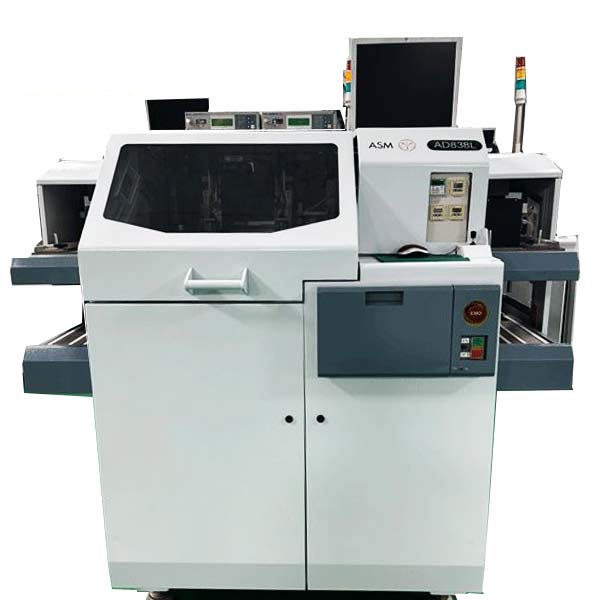
- Pick ASMPT AD830/AD838L/AD8312Plus when running high-volume, single-die epoxy or DAF packages onto uniform leadframes where peak UPH and low entry CAPEX drive gross margin.
- Pick Besi ESEC 2100 hS / FC hS when your plant prioritizes automotive-grade high-UPH consistency, low-stress thin-die peeling, or high-speed flip-chip throughput without full gantry cost.
- Pick Besi Datacon 2200 Evo or 8800 FC whenever a single substrate carries multiple mixed die sizes, tight ±3–7 µm bump alignment, waffle-pack + wafer inputs, or silver-sintering / flux-dipping stations.
5 Engineering Checks Before Commissioning a Besi or ESEC Die Bonder
- Verify Wafer Table & Ejector Architecture: Confirm 200 mm vs. 300 mm ring-frame compatibility and check whether a multi-needle or needleless thin-die ejector is installed.
- Inspect Automatic Tool Bank & Collets: Check tool-changer repeatability and confirm whether rubber, tungsten-carbide, or Vespel pickup collets match your die dimensions.
- Validate Look-Up / Look-Down Vision Calibration: Run a 3σ glass-die placement accuracy test across X, Y, and Theta; check coaxial and ring-LED brightness reserves on all cameras.
- Verify Software Version & PC Disk Image: Confirm Windows/OS industrial PC backup image, license dongle status, and SECS/GEM / wafer-map file format parsers.
- Confirm Spare Parts & Subsystem Repair Backing: Verify direct supply of Besi die bonder spare parts, accessories, PR optical module repair, and servo drive repair.
Related Besi Datacon, ESEC & Flip-Chip Resources
Frequently Asked Questions
What is the main difference between Besi Datacon 2200 Evo and Datacon 8800 FC Quantum?
The Datacon 2200 Evo is a versatile multi-chip die bonder (±5–10 µm) designed for mixed SiP, sensor, epoxy, DAF, and general flip-chip assembly across wafers, waffle packs, and tape feeders. The Datacon 8800 FC Quantum steps up to dedicated high-accuracy flip-chip and advanced packaging (±3–5 µm) with stiffer gantry dynamics and optimized high-speed flux-dipping/TCB options.
What is the difference between ESEC 2100 hS and ESEC 2100 FC hS?
ESEC 2100 hS is configured for ultra-high-speed face-up epoxy and DAF die bonding onto leadframes and BGA strips, whereas ESEC 2100 FC hS integrates a precision high-speed die flipper and flux-dipping unit specifically for mass-reflow flip-chip assembly.
Can a Besi Datacon 2200 bond both 8-inch and 12-inch wafers?
Yes—provided the machine is configured with the 300 mm wafer table and matching 200 mm adapter rings/cassettes. Always verify the physical wafer-stage stroke and Automatic Wafer Changer (AWC) cassette rack size before ordering.
Does GK-SEMI support Besi Fico molding and trim-and-form tools alongside Datacon bonders?
Yes. Alongside Datacon and ESEC die bonders, GK-SEMI supplies Besi Fico molding presses and Compact Line trim-and-form systems plus verified Besi spare parts.