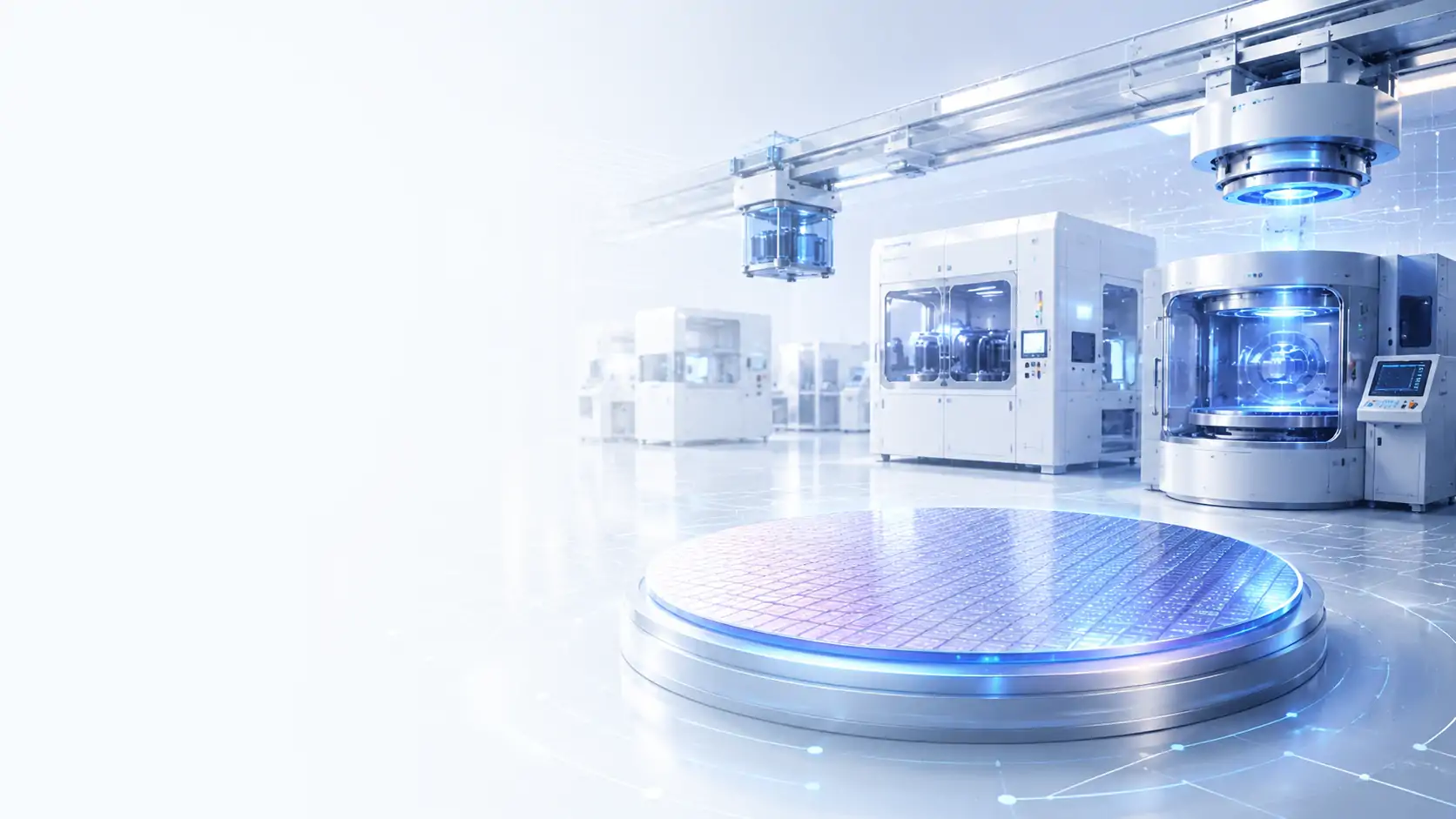
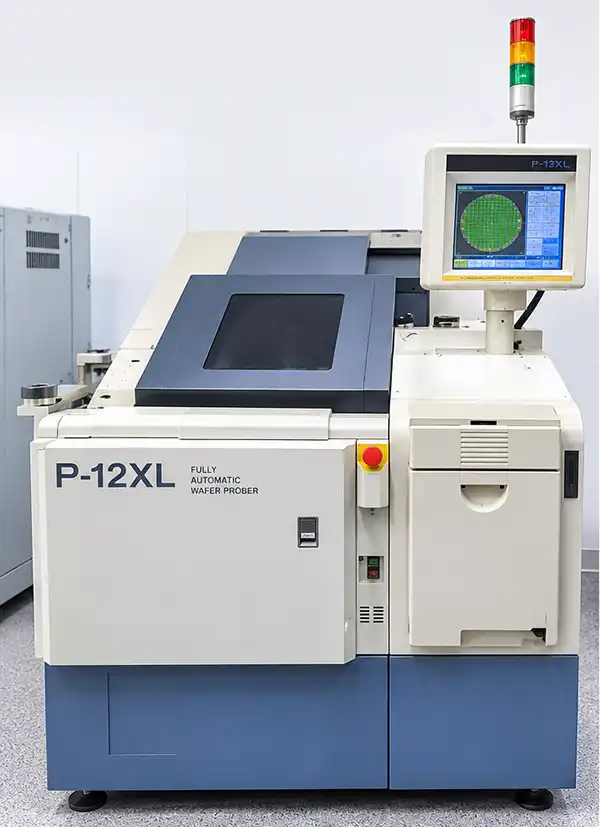
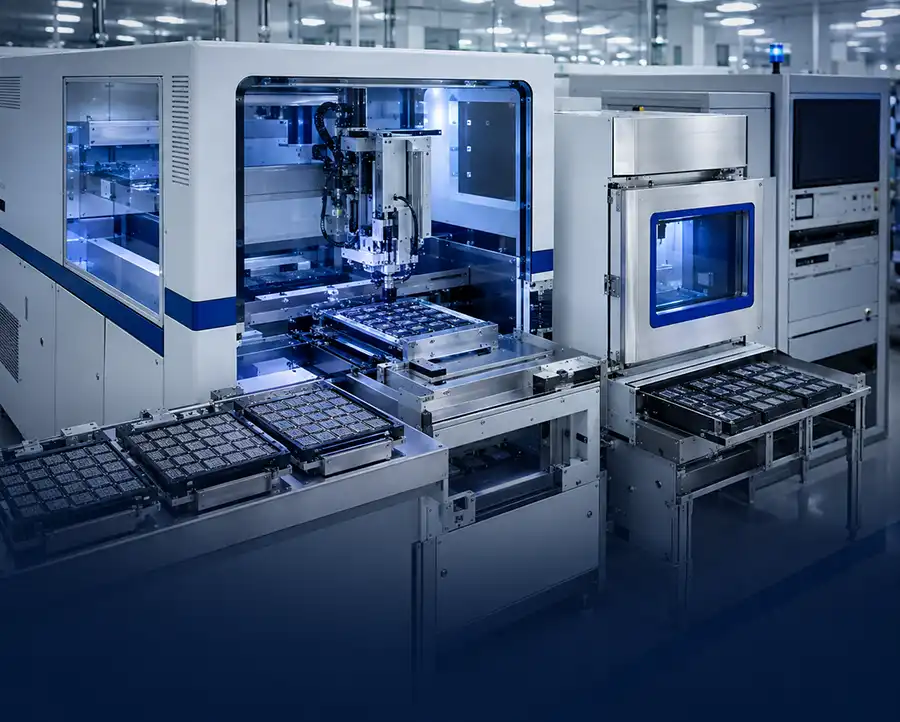
Engineering Summary: Semiconductor plasma cleaning equipment removes nanoscale organic films, epoxy bleed-out, and metal oxides inside a 100–500 mTorr vacuum chamber using ionized O2, Ar, or H2/N2 gas prior to die bonding, wire bonding, underfill, and transfer molding. Properly tuned 13.56 MHz RF or 2.45 GHz microwave plasma drops surface water contact angle below 15–20°, raises wire-bond pull strength by 15–30%, and virtually eliminates mold-compound delamination.
- Batch Magazine Plasma Cleaners: High capacity for QFN/BGA leadframe magazines and trays (Nordson MARCH AP-300 / AP-600, PVA TePla IoN 200).
- Inline Strip Plasma Systems: Direct magazine-to-magazine automation for high-volume wire-bond and flip-chip lines (Panasonic PSX307).
- Gas Chemistry Rule: O2 strips hydrocarbons/epoxy bleed; Ar physically sputters stubborn oxides; Ar/H2 reduces copper oxidation without roughening gold pads.
Why Plasma Cleaning Is Mandatory in Modern Packaging Lines
Even inside an ISO Class 6 cleanroom, leadframes, BT organic substrates, and silicon bond pads accumulate invisible monolayers of epoxy outgassing, mold-release silicones, and native oxide within hours of baking. On a wire bonder, a 3-nanometer organic film on a silver-plated lead finger is enough to trigger Non-Stick on Lead (NSOL) alarms; on a flip-chip or QFN molding line, hydrophobic substrate surfaces trap air pockets that fail MSL-1/MSL-3 popcorning tests.
A semiconductor plasma cleaner solves this dry—without wet chemical baths or thermal stress—by striking a low-temperature glow discharge inside a vacuum chamber. Excited oxygen radicals volatilize organic carbon chains into CO2 and H2O vapor pumped directly out of the chamber, while argon ions gently scrub surface oxides and create polar hydroxyl sites that dramatically increase adhesive and epoxy wetting.
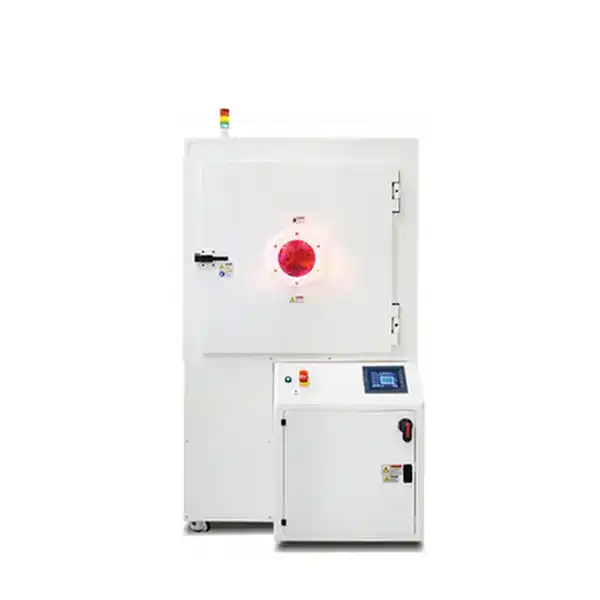
Comparing Plasma Cleaning Equipment Architectures & Gas Recipes
| Plasma Mode / Platform | Mechanism & ESD Safety | Ideal Packaging Step | Catalog Systems |
|---|---|---|---|
| Direct RF Capacitive (RIE / Electrode Shelves) | Combined chemical radical + directional ion bombardment; fast sputter cleaning on metallic leadframes | Pre-wire-bond Ag/Cu leadframe cleaning, pre-molding adhesion activation | Nordson MARCH AP-600, AP-300 |
| Downstream / Faraday-Shielded RF | Shields sensitive CMOS/GaN dies from charged ion current; pure chemical radical action | ESD-sensitive fine-pitch IC wire bond, MEMS cavities, pre-underfill flux removal | PVA TePla IoN 200, Nordson MARCH AP-series w/ Faraday cage |
| Inline Strip RF Plasma | Single-strip continuous magazine-to-magazine handling with tightly repeatable per-strip dose | High-volume automotive QFN/BGA lines requiring zero batch queue-time drift | Panasonic PSX307 |
| Microwave 2.45 GHz Plasma | Ultra-high radical density, near-zero ion energy; fast isotropic organic stripping | Wafer-level photoresist ashing, thick polymer descum, sensitive optoelectronic packages | PVA TePla GIGA 690, GIGAbatch 360M |
Selecting the Right Process Gas Mix (O2, Ar, H2, CF4)
- Pure Argon (Ar, 100–300 W): Used when cleaning bare copper leadframes or gold-plated bond pads where oxygen would oxidize copper surfaces. Argon sputters organic films mechanically without creating copper oxide—though over-powering Ar can re-sputter metal onto adjacent insulators.
- Oxygen + Argon Blend (e.g., 20% O2 / 80% Ar): The workhorse recipe for pre-wire-bond BGA strips, pre-underfill flip chips, and pre-molding QFN strips—balancing aggressive organic removal with gentle oxide scrubbing.
- Forming Gas (95% Ar or N2 + 5% H2): Actively reduces thin native copper oxide (CuO/Cu2O) back to metallic copper right before copper wire bonding or silver sintering without using hazardous pure hydrogen cabinets.
5-Step Inspection Protocol Before Accepting a Plasma Cleaning Machine
- Verify RF Generator & Auto-Matchbox Health: Confirm stable 13.56 MHz forward power up to full rated wattage (typically 300–600 W on AP-300/AP-600) with reflected power staying below 1–3 W across recipe ignition.
- Perform Vacuum Base-Pressure & Rate-of-Rise Leak Test: Pump the chamber down to base pressure (< 20–50 mTorr depending on dry pump type), isolate the valve, and confirm pressure rise remains within OEM spec—air leaks ruin Ar/H2 oxide reduction.
- Audit Mass Flow Controller (MFC) Calibration: Check all 2–4 gas channels (O2, Ar, H2/N2, CF4) for zero-drift and responsive setpoint settling; mismatched gas ratios destroy etch uniformity across chamber shelves.
- Inspect Chamber Electrode Configuration: Verify direct-plasma vs. downstream perforated shelf plates, anodized aluminum wear, quartz viewing window cleanliness, and magazine/boat fixtures matching your exact strip size.
- Confirm Repair & Spare Continuity: RF power supplies, auto-matchbox vacuum capacitors, dry pumps, and MFCs are the four service items on every plasma cleaner—ensure direct access to RF generator repair, matchbox repair, and MFC calibration.
Related Plasma Cleaning Systems, Repair & Diagnostics
Frequently Asked Questions
How long does plasma surface activation last before parts must be wire bonded or molded?
Hydrophobic recovery depends on substrate material and cleanroom humidity. Most OSAT specifications enforce a strict 2-to-8 hour queue-time limit between plasma cleaning and wire bonding, underfill, or transfer molding; parts exceeding the window are re-cleaned once before processing.
Should I use a dry vacuum pump or an oil-sealed rotary vane pump on a semiconductor plasma cleaner?
Always choose an oil-free dry vacuum pump (or PFPE-prepared pump if running high-concentration O2) for semiconductor assembly. Standard hydrocarbon pump oil can backstream into the chamber during venting, re-depositing the exact organic contamination the plasma cleaner is meant to remove—and creates an explosion hazard with pure oxygen.
What is the difference between Nordson MARCH AP-300 and AP-600 plasma cleaners?
Both share Nordson MARCH's proven 13.56 MHz RF direct/downstream shelf architecture, with the AP-600 providing roughly twice the internal chamber volume and shelf capacity of the AP-300—making AP-600 ideal for high-volume batch leadframe magazines and AP-300 ideal for medium-volume or R&D cells with tight floor space.
Can plasma cleaning damage ESD-sensitive CMOS or GaN semiconductor devices?
Direct high-voltage RF plasma can induce charge accumulation on floating gate structures if configured improperly. Using a grounded Faraday shield / downstream perforated electrode rack neutralizes charged ions while letting reactive neutral radicals clean the surface safely with zero ESD gate damage.