What Is a K&S ICONN Wire Bonder?
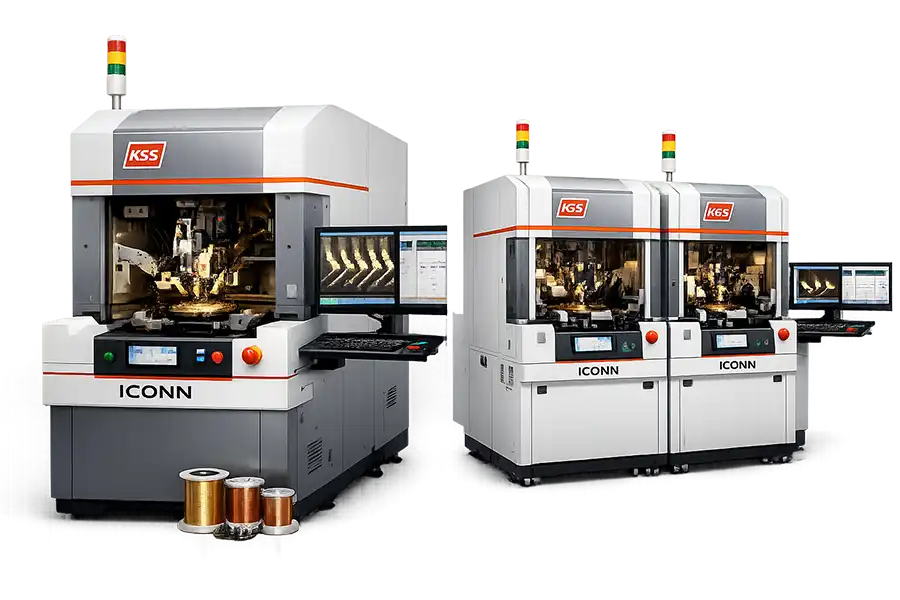
K&S ICONN refers to a family of automatic thermosonic ball wire bonders used in semiconductor assembly and packaging.
The equipment forms fine-wire connections between a semiconductor die and a leadframe or substrate through controlled ball formation, first bonding, loop formation and second bonding.
Ball Formation
The system forms a free-air ball at the end of fine wire using the electronic flame-off system and the required process environment.
First Bond
The capillary places the ball onto the semiconductor die pad while heat, bond force and ultrasonic energy create the connection.
Loop Formation
Programmable motion controls the wire trajectory, loop height, shape and clearance between the die and package connection point.
Second Bond
The wire is bonded to the leadframe or substrate terminal, then clamped and separated before the machine begins the next wire.
K&S ICONN Models and Common Configuration Names
Used-equipment listings may shorten or combine model names. The following map explains how the common ICONN search terms are usually separated when evaluating equipment.
K&S ICONN
Broad family reference for automatic ball wire bonding equipment. The complete machine suffix and configuration should be confirmed.
K&S ICONN PLUS
A later ICONN platform designation used for production wire bonding equipment with configuration-dependent process capability.
K&S ICONN ProCu
ICONN equipment associated with copper wire process requirements, including EFO, gas delivery and copper-oriented process control.
ICONN ProCu PLUS
A later copper bonding generation introduced with upgraded subsystems and the ProCu5 process platform.
ProCu PLUS LA
Factory large-area configuration developed for packages requiring a wider bondable area and suitable material-handling hardware.
ProCu PLUS ELA
Extended large-area configuration requiring verification of the actual indexer, clamp, heater block, software and upgrade history.
How an ICONN Ball Wire Bonder Creates an Interconnect
The precise recipe varies by wire, package, capillary and machine configuration, but automatic ball bonding normally follows the same four-stage production sequence.
Locate the Die Pad
Machine vision identifies the die and package reference points and applies the programmed alignment correction.
Form and Place the Ball
EFO forms the free-air ball before the bond head places it onto the selected die pad.
Create the Wire Loop
Programmable bond-head movement forms the required loop profile, height and direction.
Complete the Second Bond
The machine creates the second bond, separates the wire and continues to the next programmed connection.
ICONN, ICONN ProCu and ProCu PLUS Compared
Model names indicate the general platform direction, but they do not replace a machine-specific configuration check.
How to Select the Correct K&S ICONN Configuration
Start with the package and process rather than selecting a machine only from a model name or advertised production speed.
A drawing, existing process sheet or current equipment nameplate can significantly reduce the number of configurations that need review.
- Wire material and diameter
- Die pad and package geometry
- Leadframe or substrate dimensions
- Loop height and profile
- Required bondable area
- Production volume and condition
- Existing tooling and process files
01 Wire Material Gold, copper and alloy wire require different process hardware and settings.
Confirm wire composition, diameter, spool type, required EFO conditions, cover gas, capillary and whether a qualified process already exists.
02 Package and Leadframe Machine travel alone does not confirm that a package can be transported and clamped.
Review package width, matrix layout, rail geometry, index direction, heater block, clamp opening and bond locations.
03 Looping Requirements Stacked dies and dense interconnects require suitable loop control and physical access.
Confirm loop height, wire length, crossing restrictions, die stack, capillary clearance and the software functions required by the package.
04 Bondable Area Standard, LA and ELA names should be verified against the actual machine.
Request the equipment option list and measure the practical bonding and handling range with the installed indexer, clamp and heater block.
05 Software and Process Files Mechanical compatibility does not guarantee process portability.
Compare software revisions, licenses, process-library support, computer hardware, backup status and recipe compatibility with the existing production line.
06 Machine Condition Used equipment should be supported by inspection and operating evidence.
Review service history, operating hours where available, bond-head condition, transducer, vision, EFO, indexer, computer and extended dry-run evidence.
Common Applications for ICONN Ball Bonding Platforms
Application suitability depends on the exact machine, tooling and process configuration rather than the family name alone.
Leadframe IC Packages
Fine-wire interconnection between semiconductor die pads and leadframe package terminals.
Substrate-Based Packages
Wire bonding between the die and organic, ceramic or other package substrates using compatible material handling.
Stacked-Die Packaging
Multi-level die structures requiring controlled loop profiles, clearances and programmable bonding sequences.
System-in-Package
Packages combining multiple dies or components where flexible wire routing supports internal electrical interconnection.
Copper Wire Conversion
Production programs moving from gold to copper wire after confirming pad, capillary, gas, EFO and reliability requirements.
Capacity Expansion
Additional equipment for factories seeking compatibility with existing ICONN process libraries, tooling and operator experience.
What to Check Before Buying a Used ICONN Wire Bonder
Model-name matching is only the first stage. A used machine should also be checked for hardware condition, installed options, software status and practical package compatibility.
A powered dry run confirms basic machine operation but does not replace a qualified bonding test using the intended package, wire, capillary and process recipe.
Nameplate and Configuration
Record the exact model, serial number, year, suffix, option list and any LA or ELA identification.
Bond Head and Transducer
Inspect Z movement, bond force, ultrasonic response, wire clamp, capillary interface and abnormal noise.
Vision and Alignment
Confirm camera condition, lighting, focus, pattern recognition, stage movement and alignment repeatability.
Indexer and Tooling
Verify track width, transport, clamp, heater block, package tooling and included change parts.
EFO, Gas and Pneumatics
Check EFO operation, gas valves, regulators, flow components, pneumatic pressure and leakage.
Software and Computer
Record software revisions, licenses, computer condition, storage, process files, manuals and available backups.
Continue the Wire Bonder Selection
Review the copper-specific ICONN page or continue to related semiconductor assembly equipment.
Review copper wire process requirements, ProCu generations and configuration verification.
Wire Bonder Machines
Compare automatic ball bonders, wedge bonders and other semiconductor wire bonding equipment.
Die Bonder Equipment
Review die attach and precision placement equipment used before the wire bonding stage.
Configuration Review
Send the package, wire and equipment requirement for a model and configuration comparison.
K&S ICONN Wire Bonder FAQ
Common questions about the ICONN family, wire materials, applications and used equipment selection.
What is a K&S ICONN wire bonder?
It is an automatic thermosonic ball bonding platform used to create fine-wire electrical connections between semiconductor die pads and leadframes or package substrates.
Is K&S ICONN a single machine model?
No. ICONN is commonly used as a family name. Equipment may be identified as ICONN, ICONN PLUS, ICONN ProCu, ProCu PLUS, LA or ELA, depending on generation and configuration.
What wire materials can an ICONN bonder use?
Wire capability depends on the installed bond head, EFO, gas delivery, software, capillary and process setup. Confirm gold, copper or alloy capability for the specific machine.
What is the difference between ICONN and ICONN ProCu?
ICONN is the broader automatic ball bonder family, while ProCu identifies configurations developed around copper wire bonding requirements.
What is the difference between ProCu and ProCu PLUS?
ProCu PLUS is a later copper bonding generation introduced with upgraded subsystems and the ProCu5 process platform.
Can ICONN machines process stacked-die packages?
Some configurations may support stacked-die applications, but loop height, die geometry, capillary access, tooling and software must be matched to the actual package.
What should be checked on a used ICONN wire bonder?
Check the model, serial number, year, bond head, transducer, EFO, gas system, optics, indexer, clamp, heater block, software, computer, tooling and operating evidence.
What information is needed to select an ICONN model?
Provide the wire material and diameter, package drawing, leadframe or substrate dimensions, loop requirements, bondable area, production condition and preferred machine year.