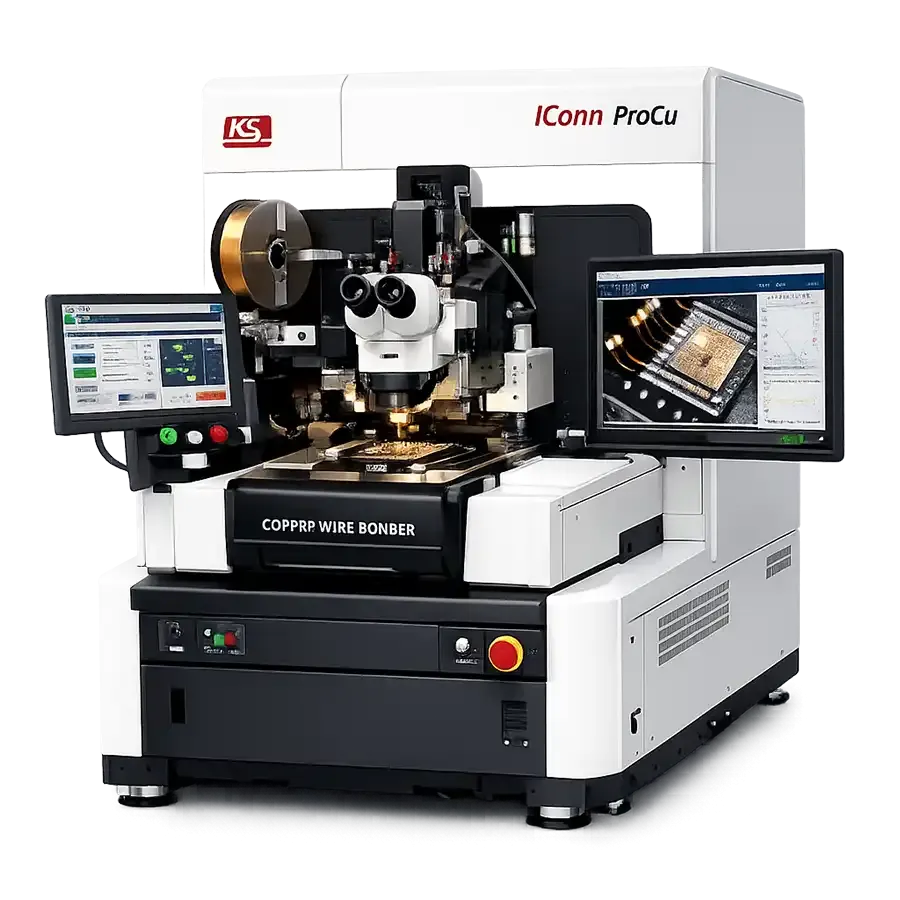
What Is the K&S ICONN ProCu?
K&S ICONN ProCu identifies an ICONN automatic ball bonder configuration developed around the requirements of copper wire semiconductor packaging.
Copper wire changes the requirements for free-air-ball formation, protective atmosphere, capillary selection, bond parameters, pad interaction and process qualification.
Copper Free-Air Ball
Copper ball formation requires suitable EFO settings and a controlled atmosphere to reduce oxidation during the formation stage.
First-Bond Control
Bond force, ultrasonic energy, timing and capillary geometry must be matched to the copper wire and semiconductor pad structure.
Loop Formation
Programmable loop motion must control wire trajectory while avoiding excessive stress, interference or package clearance problems.
Second-Bond Stability
Stitch formation, tail control, wire separation and package-surface interaction must remain stable throughout continuous production.
Copper Wire Bonding Requires a Complete Process System
A stable copper process depends on several connected subsystems. A machine should not be selected solely because a sales listing contains the word “ProCu.”
EFO and Ball Formation
EFO current, timing, electrode condition, wire position and process atmosphere influence copper free-air-ball shape and consistency.
Protective Gas Delivery
Gas type, purity, flow, nozzle position, regulator stability, valves and tubing condition affect oxidation control during ball formation.
Capillary and Pad Interaction
Capillary geometry, wire diameter, pad metallurgy, pad thickness and underlying structure influence the usable bonding window.
Force and Ultrasonic Response
Bond force, ultrasonic energy, timing and machine mechanical condition must work together to create repeatable interconnects.
K&S ICONN ProCu vs. ICONN ProCu PLUS
ProCu and ProCu PLUS should be treated as related but different equipment generations. The later name does not simply describe the same machine with a cosmetic label change.
Six Areas That Determine Copper Bonding Stability
These process areas should be reviewed when qualifying a machine, transferring a recipe or investigating inconsistent bonding results.
Wire Specification
Confirm copper composition, diameter, spool condition, storage and compatibility with the target process.
Capillary Geometry
Hole size, chamfer, tip diameter, face angle and material must suit the wire and package geometry.
Gas Environment
Gas purity, flow stability, nozzle position and enclosure conditions affect free-air-ball oxidation.
Die Pad Structure
Pad metallurgy, thickness, contamination and underlying structures affect the safe bonding window.
Machine Condition
Bond-head mechanics, transducer, force control, EFO and wire clamp condition influence process repeatability.
Recipe Management
Parameter control, software version, process files and change management affect portability between machines.
What to Verify on an ICONN ProCu Machine
The model name should be supported by photos, an option list and operating evidence from the specific machine being evaluated.
Share the process and package information already available before comparing equipment.
- Wire composition and diameter
- Die pad and package drawing
- Leadframe or substrate format
- Loop and bond requirements
- Current qualified machine
- Preferred generation and condition
- Tooling and process-file requirements
01 Model and Process Generation Separate earlier ProCu machines from ProCu PLUS and later configurations.
Record the exact model, serial number, year, machine suffix, software version and installed process-package information.
02 EFO Hardware Stable copper ball formation depends on the condition and control of the EFO system.
Check EFO operation, electrode condition, wire position, cabling, alarms, calibration and available demonstration evidence.
03 Gas Delivery Confirm that the machine includes the required copper gas-delivery components.
Inspect gas nozzles, regulators, valves, flow components, tubing, connections and pressure stability.
04 Bond Head and Transducer Mechanical and ultrasonic condition influence the usable process window.
Review bond-head movement, force control, transducer condition, wire clamp, capillary interface and maintenance history.
05 Indexer and Package Tooling The copper process is only useful if the target package can be transported and clamped.
Verify track width, transport range, clamp, heater block, package orientation, bondable area and included change parts.
06 Software and Process Files Check compatibility with existing qualified programs and production requirements.
Record software revisions, licenses, process files, computer condition, storage backup and communication interfaces.
Moving a Copper Recipe to Another ICONN Machine
Process files alone do not guarantee equivalent bonding performance. The receiving machine, tooling, materials and environmental conditions must be compared with the qualified source machine.
Final acceptance should be based on the customer's own validation method, package, wire and reliability requirements.
Compare the Machines
Compare model generation, bond head, transducer, EFO, gas system, software, indexer and tooling.
Confirm the Materials
Match wire, capillary, die pad, leadframe or substrate, gas and package surface conditions.
Establish a Starting Recipe
Transfer qualified parameters only after checking software compatibility and machine-specific offsets.
Validate the Process
Review ball formation, first bond, loop, second bond, visual results, pull or shear data and required reliability testing.
Inspection Points for a Used ICONN ProCu
Copper-oriented machines require the usual mechanical and software checks plus additional verification of EFO and gas-delivery hardware.
Request evidence from the actual serial number rather than using a demonstration from another machine in the same model family.
Nameplate and Options
Record the model, serial number, year, suffix, process generation and installed option information.
Bond Head Operation
Check Z movement, force control, transducer, wire clamp, capillary holder and abnormal noise.
EFO and Copper Ball Test
Verify EFO operation and, where practical, request evidence of stable free-air-ball formation.
Gas System Check
Inspect regulators, valves, nozzles, tubing, flow control, alarms and leakage.
Vision and Material Handling
Test camera, lighting, pattern recognition, indexer, clamp, heater block and package transport.
Software and Demonstration
Record software, licenses, computer, process files, backups and available dry-run or bonding evidence.
Continue the ICONN and Copper Bonding Research
Return to the broader ICONN family guide or compare related semiconductor assembly equipment.
K&S ICONN Series
Compare ICONN, ICONN PLUS, ProCu, ProCu PLUS, LA and ELA model positioning.
Wire Bonder Machines
Browse automatic ball bonders, wedge bonders and related semiconductor interconnect equipment.
Plasma Cleaner
Review surface-cleaning equipment for package preparation and improved process consistency.
ProCu Configuration Review
Send the package, wire and machine requirement for a configuration and availability review.
K&S ICONN ProCu FAQ
Common questions about the ProCu platform, copper process requirements, model generations and used equipment evaluation.
What is the K&S ICONN ProCu?
It is an automatic thermosonic ball wire bonder configuration developed around copper wire semiconductor packaging requirements.
Why does copper wire bonding need a ProCu configuration?
Copper bonding requires controlled ball formation, suitable EFO conditions, protective gas delivery, compatible capillaries and carefully developed bonding parameters.
What is the difference between ProCu and ProCu PLUS?
ProCu PLUS is a later generation introduced with upgraded subsystems and the ProCu5 process. Earlier ProCu equipment should not be assumed to have identical capability.
Does every ICONN ProCu have the same bondable area?
No. The practical area depends on the model generation, indexer, clamp, heater block, software and any later upgrades.
Can ICONN ProCu bond gold wire?
Wire capability must be confirmed from the installed hardware, software, EFO, gas system, capillary and process history. Do not assume every copper-configured machine is qualified for gold wire.
What should be checked before transferring a copper process?
Compare wire, capillary, pad metallurgy, ball dimensions, gas, EFO, force, ultrasonic settings, loop profile, second bond, tooling, software and machine condition.
What should be inspected on a used ICONN ProCu?
Inspect the nameplate, bond head, transducer, wire clamp, EFO, gas delivery, vision, indexer, clamp, heater block, software, computer and tooling.
What information is needed for an ICONN ProCu inquiry?
Provide the required generation, wire material and diameter, package drawing, leadframe or substrate dimensions, tooling needs, preferred condition and destination.