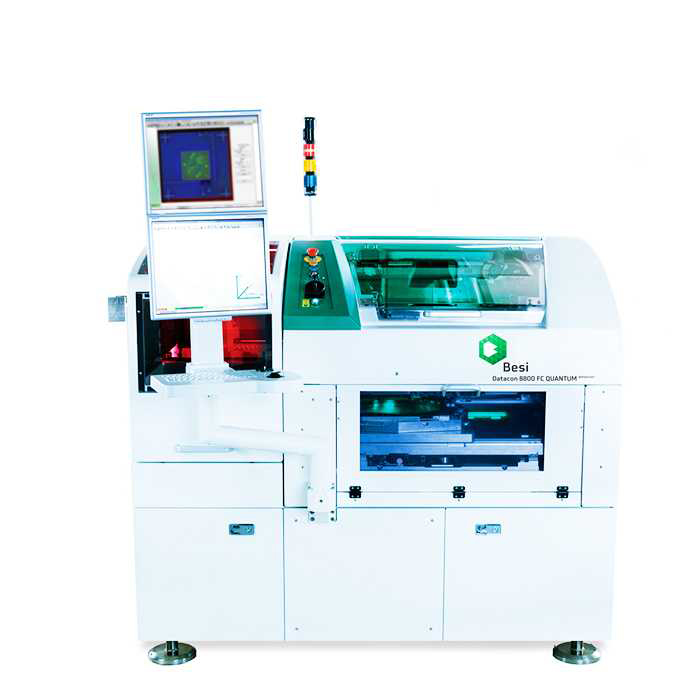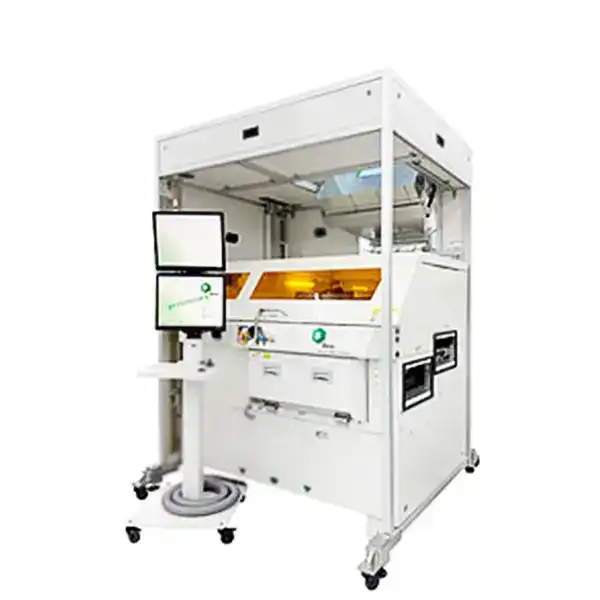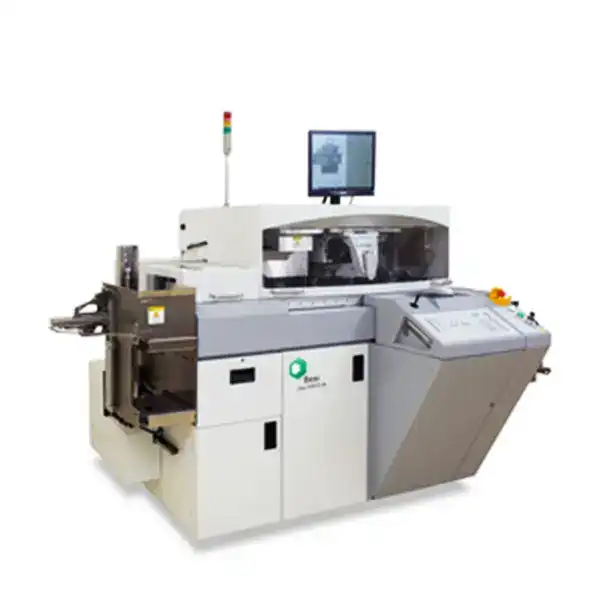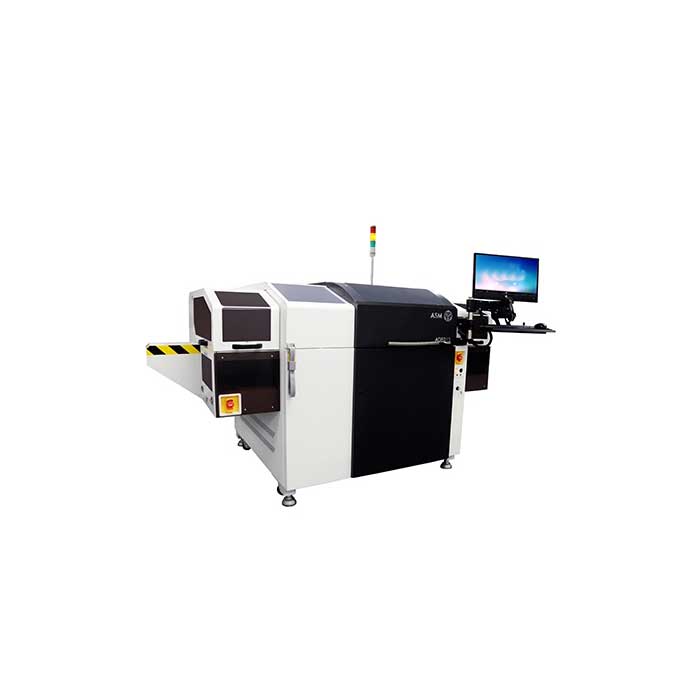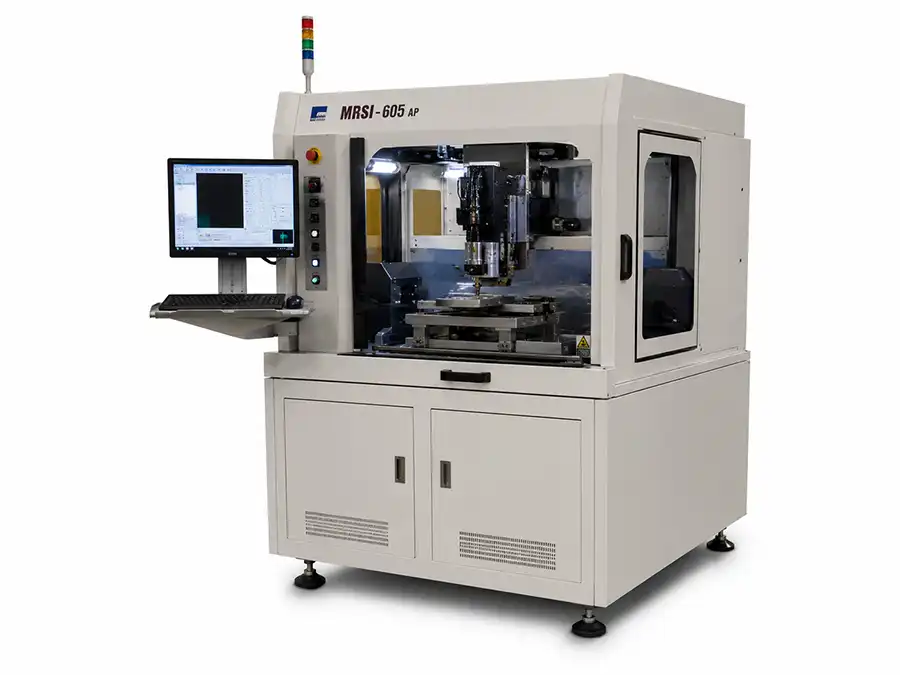
What Is the MRSI-605 AP Die Bonder?
The MRSI-605 AP was introduced as an advanced packaging die bonder and ultra-precision automated assembly work cell. It was designed for high-speed, high-precision assembly of microelectronic and optoelectronic products rather than only laboratory positioning or manual prototype work.
Historical platform applications included microwave modules, optical modules, hybrid circuits, multi-chip modules, MEMS devices, photonics packages and advanced semiconductor packages. Depending on the installed configuration, the equipment could perform epoxy die attach, eutectic bonding and flip-chip assembly.
The equipment may appear in machine records under the names MRSI-605 AP, MRSI-605 or Newport MRSI-605. This naming difference is related to its production history and should not be used to determine the installed capability.
This page is positioned around used equipment sourcing, configuration verification, legacy process compatibility and technical recovery. For the documented 5 μm platform, visit the MRSI-705 die bonder page.
When does an MRSI-605 still make sense?
An MRSI-605 is most relevant when a factory already has a validated 605 process, existing fixtures, component programs, trained operators or spare tooling.
It may also be suitable when a correctly configured and supportable machine provides a lower-risk path than transferring a mature product to an unrelated platform.
It should not be selected only because its purchase price is lower. Missing software, tooling or process modules can make a low-cost machine difficult to recover.
Three Practical Reasons to Source an MRSI-605
The page focuses on the requirements most likely to produce a qualified equipment inquiry rather than repeating generic MRSI die bonder information.
Replace an Existing MRSI-605
A closely matched machine can help preserve existing production programs, fixtures, process knowledge and operator procedures after a major equipment failure.
Expand a Validated Legacy Process
An additional compatible platform may reduce the engineering work required to introduce capacity for a mature product or long-term production program.
Rebuild a Specialized Assembly Cell
A complete MRSI-605 configuration may be useful when original tooling, heated stages, material handlers or application knowledge remain available.
MRSI-605 AP Technical Capability Overview
Complete factory specifications are not available for every production year and configuration. The following information separates historically documented platform capabilities from functions that must be verified on the actual used machine.
Core Platform and Process Information
| Item | Historically Documented Information | What Must Be Confirmed |
|---|---|---|
| Formal model name | MRSI-605 AP Advanced Packaging Die Bonder / Ultra-Precise Assembly Work Cell | Read the model plate, serial number, build year and original machine records. |
| Other market names | MRSI-605 and Newport MRSI-605 | Do not assume machines with different listing names have the same hardware. |
| Equipment function | Automated precision assembly of microelectronic and optoelectronic devices | Confirm whether the available system is complete and capable of automatic production. |
| Bonding processes | Epoxy die attach, eutectic bonding and flip-chip bonding were offered on historical configurations | Verify dispensers, flux or dipping hardware, heated stages, scrub, flip mechanism and software. |
| Placement accuracy | Historical Newport references describe 8 μm or 10 μm, depending on the platform record and application configuration | Request calibration data and run an acceptance test using the intended die and substrate. |
| Force control | Closed-loop placement-force control was a documented platform capability | Verify bond head, load cell, force range, calibration status and feedback performance. |
| Vision and lighting | Historical descriptions identify advanced machine vision and programmable lighting | Check cameras, optics, illumination, vision boards, pattern recognition and calibration. |
| Material presentation | Waffle pack, Gel-Pak, wafer and feeder presentation were available | Confirm exactly which stations, ejectors, holders and feeder bases are installed. |
| Production positioning | High-speed, high-precision automated assembly work cell | Throughput depends on the specific process, material input and machine configuration. |
Historically Documented Applications
| Application Group | Typical Products | Configuration Requirement |
|---|---|---|
| Photonics | Optical modules, laser packages, detectors and TO-style photonic assemblies | May require heated stages, rotation, special collets, gas control or dispensing. |
| Microwave and RF | MMICs, RF circuits, power devices and hybrid microwave modules | Requires appropriate vision, tooling, force control and substrate fixtures. |
| MEMS | Sensors and devices containing delicate internal or surface structures | Force control, pickup tooling and component support must be evaluated carefully. |
| Multi-chip modules | Assemblies containing several active and passive component types | Requires sufficient tool positions, material inputs and reliable program recovery. |
| Hybrid circuits | Microelectronic and optoelectronic hybrid packages | Process capability depends on adhesive, eutectic and fixture configuration. |
| Advanced packaging | Specialized semiconductor packages and flip-chip products | Confirm flip, flux, vision, force and substrate-handling modules. |
Why MRSI-605 Accuracy Is Listed as 8–10 μm
The difference reflects historical product records and application-specific configurations, not a specification that should be averaged or guaranteed.
8 μm Placement Accuracy
A Newport corporate product description identified eight-micron placement accuracy, closed-loop placement-force control, advanced vision and lighting among the advanced features associated with the MRSI-605 AP platform.
10 μm Placement Accuracy
A separate Newport technical announcement described 10-micron placement accuracy for an MRSI-605 configured for automated eutectic assembly of TO packages.
MRSI-605 AP Bonding Processes
The MRSI-605 AP platform was introduced to support several advanced packaging processes, but the corresponding hardware is not present on every used machine.
Epoxy Die Attach
Configured systems could support adhesive-based die placement for microwave modules, optical modules, hybrids, MEMS and multi-chip products. Verify dispensing or dipping hardware, material control and cure workflow.
Eutectic Bonding
Application-specific configurations supported direct eutectic and preform-based reflow processes. Heated stages, scrub control, cover gas and package tooling must be confirmed.
Flip-Chip Bonding
The MRSI-605 AP was promoted for flip-chip assembly as well as conventional die attach. Verify die inversion, flux handling, upward vision, substrate alignment and controlled placement capability.
MRSI-605 TO Package Eutectic Configuration
Newport documented a specialized MRSI-605 configuration for automated eutectic assembly into transistor-outline packages. These functions must not be described as standard on every 605.
TO Package Loading and Positioning
The documented configuration used automatic material handling with package clamping and rotation for die placement onto perpendicular surfaces.
Gold-Silicon Bonding
The system supported direct gold-silicon eutectic assembly using controlled temperature, placement force and programmed scrub.
Gold-Tin and Gold-Germanium
The documented option supported eutectic reflow using gold-tin or gold-germanium preforms for suitable photonics and high-reliability packages.
Programmable Temperature to 500°C
The application-specific stage used programmable closed-loop temperature control with a documented maximum of approximately 500°C.
Variable Amplitude and Frequency
An inverted-pyramid collet could place the die while applying programmable scrub to support eutectic reflow and oxide disruption.
Heated H₂/N₂ Cover Gas
The documented process used a heated hydrogen and nitrogen gas mixture over the hot plate to support the eutectic bonding environment.
Closed-Loop Feather-Touch Force
Closed-loop force feedback supported the controlled handling of sensitive devices such as GaAs and InP components.
Typical MRSI-605 AP Applications
The equipment was positioned for automated assembly where component alignment, controlled placement and process flexibility were required.
Photonics Packages
Laser, detector, optical module and TO-package assembly using process-specific epoxy or eutectic configurations.
MEMS Devices
Placement of sensors and delicate components requiring controlled pickup and placement force.
Microwave Modules
MMIC, beam-lead, RF power and other high-frequency hybrid assemblies.
RF Circuits
Precision assembly of RF components and semiconductor devices onto specialized substrates.
Multi-Chip Modules
Products containing multiple die types, package materials and placement sequences.
Military and Defense Hybrids
Long-life high-reliability products where preservation of an established legacy process may be important.
What Must Be Checked Before Buying an MRSI-605?
A legacy die bonder should be evaluated according to completeness, process compatibility and recoverability. The machine price alone does not show the true project cost.
Information Needed to Find the Correct MRSI-605
A detailed request reduces the risk of receiving quotations for incomplete or incompatible legacy machines.
For an Existing MRSI-605 Replacement
Provide information from the existing production machine whenever possible.
- Model plate and serial-number photograph
- Production year and software version
- Machine front, interior and tooling photographs
- Bond-head, camera and material-input configuration
- Existing programs, fixtures and package type
- Known fault or reason for replacement
For a New Legacy Equipment Project
Describe the intended product and process before requesting availability.
- Epoxy, eutectic or flip-chip process
- Die and substrate dimensions and materials
- Required accuracy and placement force
- Material presentation and package-handling format
- Temperature, scrub and process-gas requirements
- Destination and requested installation support
MRSI-605 AP vs MRSI-705 Die Bonder
The models should be selected according to process requirements and production compatibility rather than model number alone.
| Selection Factor | MRSI-605 AP | MRSI-705 |
|---|---|---|
| Primary page intent | Legacy equipment sourcing, replacement and process compatibility | 5 μm platform specifications, configurable processes and equipment sourcing |
| Historical positioning | Ultra-precision automated assembly work cell for microelectronic and optoelectronic products | Configurable 5 μm high-precision die bonding platform |
| Published accuracy | Historical references cite 8 μm or 10 μm depending on configuration | Published placement accuracy of ±5 μm at 3 sigma |
| Published repeatability | Must be confirmed from machine-specific records and testing | Published placement repeatability of ±1.5 μm at 3 sigma |
| Best-fit requirement | Existing 605 programs, tooling, trained operators or validated legacy processes | Projects requiring documented 5 μm capability and broader configurable platform options |
| Configuration risk | High because of machine age, missing modules, old software and varied application builds | Still configuration-dependent, but platform documentation is more complete |
| Procurement priority | Completeness, compatibility, software recovery, tooling and inspection | Accuracy, process options, force control, material handling and production fit |
| Recommended choice | Select when compatibility with an existing MRSI-605 process creates a clear advantage | Select when the project requires the documented 5 μm MRSI-705 platform |
MRSI-605 Sourcing and Technical Coordination
The objective is to establish what the machine actually includes before packing and shipment.
Machine Identification
Confirm model, serial number, year, software, location and current operational status.
Configuration Review
Check bond heads, vision, handlers, stages, dispensers, gas hardware and included tooling.
Condition Assessment
Review photographs, video, power-on tests, known faults, calibration and maintenance records.
Delivery Planning
Coordinate preparation, secure packing, transport, installation requirements and follow-up support.
MRSI-605 AP Die Bonder FAQ
What is the correct model name: MRSI-605 or MRSI-605 AP?
The formal historical product name was MRSI-605 AP Advanced Packaging Die Bonder or MRSI-605 AP Ultra-Precise Assembly Work Cell. Used-equipment listings often shorten the name to MRSI-605 or Newport MRSI-605. The machine plate and serial number should be used for final identification.
What is the placement accuracy of the MRSI-605?
Historical Newport references are not identical. One corporate description cited 8 μm placement accuracy for the MRSI-605 AP platform, while a technical announcement for a TO-package eutectic configuration cited 10 μm. The offered machine should be tested rather than advertised with one universal value.
Can the MRSI-605 perform epoxy die attach?
Epoxy die attach was one of the process categories associated with the MRSI-605 AP. The actual machine must include the required dispensing or dipping hardware, tools, material controls and process software.
Can the MRSI-605 perform eutectic bonding?
Yes, suitably configured machines supported eutectic bonding. A documented TO-package option supported direct gold-silicon bonding and reflow using gold-tin or gold-germanium preforms. Heated-stage, scrub, gas and package-handling hardware must be confirmed.
Can the MRSI-605 perform flip-chip bonding?
Flip-chip bonding was included in the historical MRSI-605 AP process positioning. The specific used machine must be checked for die inversion, upward vision, flux or dipping hardware, force control and suitable substrate tooling.
Does every MRSI-605 support temperatures up to 500°C?
No. The approximately 500°C value belongs to a specialized closed-loop heated stage documented for an automated TO-package eutectic configuration. It is not a standard specification that should be applied to every MRSI-605.
What material inputs can an MRSI-605 use?
Historical descriptions identify waffle packs, Gel-Paks, wafers and feeders as available material-presentation methods. The offered machine may include only some of these stations.
Should I choose an MRSI-605 or MRSI-705?
Choose an MRSI-605 when compatibility with an existing 605 process, tooling or production program is the main advantage. Evaluate the MRSI-705 when the project requires its documented ±5 μm platform capability and broader configurable options.
What should be inspected before purchasing a used MRSI-605?
Inspect the model identity, controller, computer, software, axes, cameras, force control, bond heads, material handlers, heated stages, dispensers, gas hardware, tooling, programs, documentation and calibration status.
Can you support inspection, packing and installation?
Inspection, configuration review, packing, transport and installation coordination can be evaluated according to the machine location, condition, destination and project requirements.